


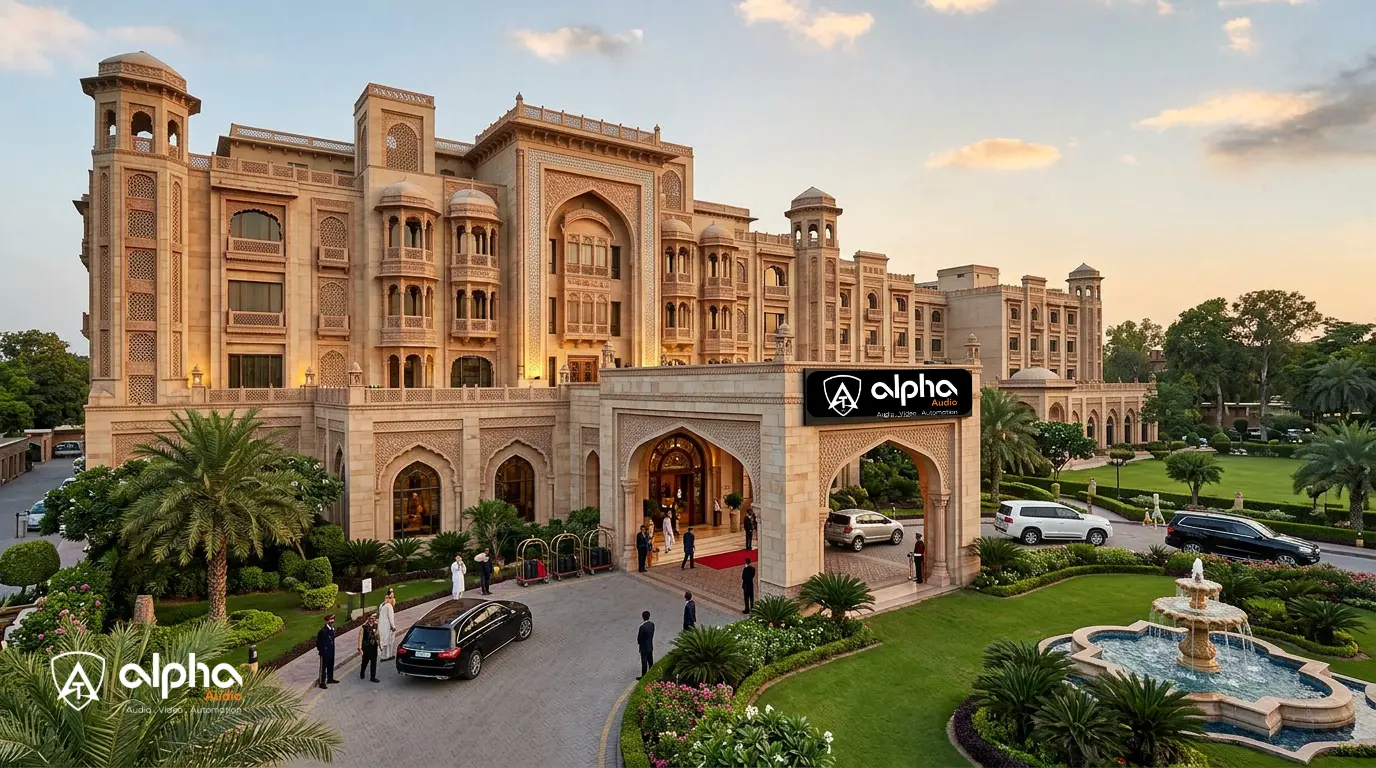
Walk into any newly opened five-star hotel in Pakistan and you can usually tell within thirty seconds whether the developers thought about sound, or assumed it would take care of itself. You hear it in the lobby where a tinny speaker fights against marble echo. You hear it in the ballroom where a wedding DJ’s bass rattles the chandeliers two floors up. You hear it in guest rooms where the corridor conversation outside is clearer than the television inside. None of this is bad luck. It is the predictable result of treating acoustics as an afterthought instead of a design discipline.
Pakistan’s hospitality sector is in the middle of a genuine construction boom. Government bodies are fast-tracking new five-star approvals in Islamabad, international chains are breaking ground in Mumtaz City and along the Kashmir Highway, and established five-star groups continue expanding across Lahore, Karachi, and Islamabad. Billions of rupees are being poured into marble lobbies, imported furniture, and rooftop restaurants. Yet sound, one of the few things every guest experiences in every space, every minute of their stay, is still treated as an electrical contractor’s afterthought rather than a strategic investment.
If you are a developer, hotel owner, architect, or operations director planning a five-star property in Pakistan, here is why a professional sound strategy belongs in your blueprint from day one, not on your punch list after the ribbon-cutting.
What “Sound Strategy” Actually Means in Hotel Design
A professional sound strategy is not the same as buying a few Bluetooth speakers for the lobby or asking the electrician to “sort out the audio.” It is a coordinated discipline that covers several interlocking layers:
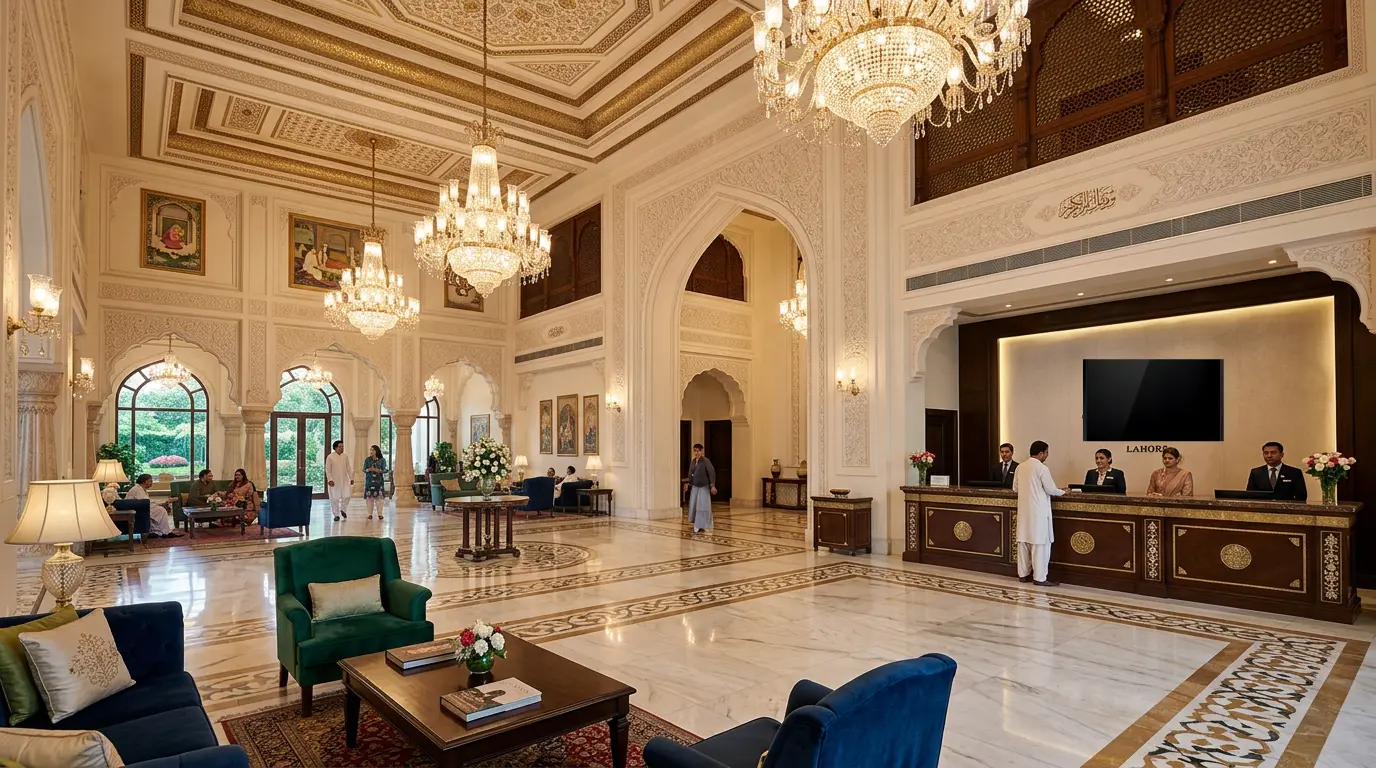
Architectural acoustics — how sound behaves inside a space because of its shape, ceiling height, and surface materials. A double-height lobby with polished marble floors and glass walls will produce harsh reverberation unless acoustic treatment is designed into the architecture before construction, not added afterward with carpets and curtains.
Sound masking and privacy — the engineered background sound used in corridors, between guest rooms, and in meeting spaces to prevent conversations and footsteps from carrying. This is standard in luxury hotels worldwide and almost entirely absent in Pakistani five-star properties.
Background music and zoning systems — multi-zone audio distribution that lets a hotel play calm instrumental music in the spa, energetic tracks by the pool, and elegant ambient sound in the lobby, all controlled centrally and tailored to the brand’s identity.
Public address and life-safety announcement systems — the audio infrastructure that must function flawlessly during fire alarms, security briefings, or emergency evacuations, in both Urdu and English, across every floor.
Event and banquet sound reinforcement — professional-grade audio for weddings, conferences, and corporate events, engineered so that sound stays contained within the ballroom and doesn’t bleed into guest rooms or adjoining function spaces.
Acoustic branding — the deliberate use of music, tone, and audio identity to reinforce what the hotel wants guests to feel, the same way scent marketing and lighting design already shape five-star experiences.
When these layers are planned together, by an acoustic consultant and AV designer working alongside the architect, the result is invisible in the best possible way: guests simply feel comfortable, calm, and impressed, without ever knowing why.
Why Sound Strategy and KNX Automation
Belong on the Same Design Table
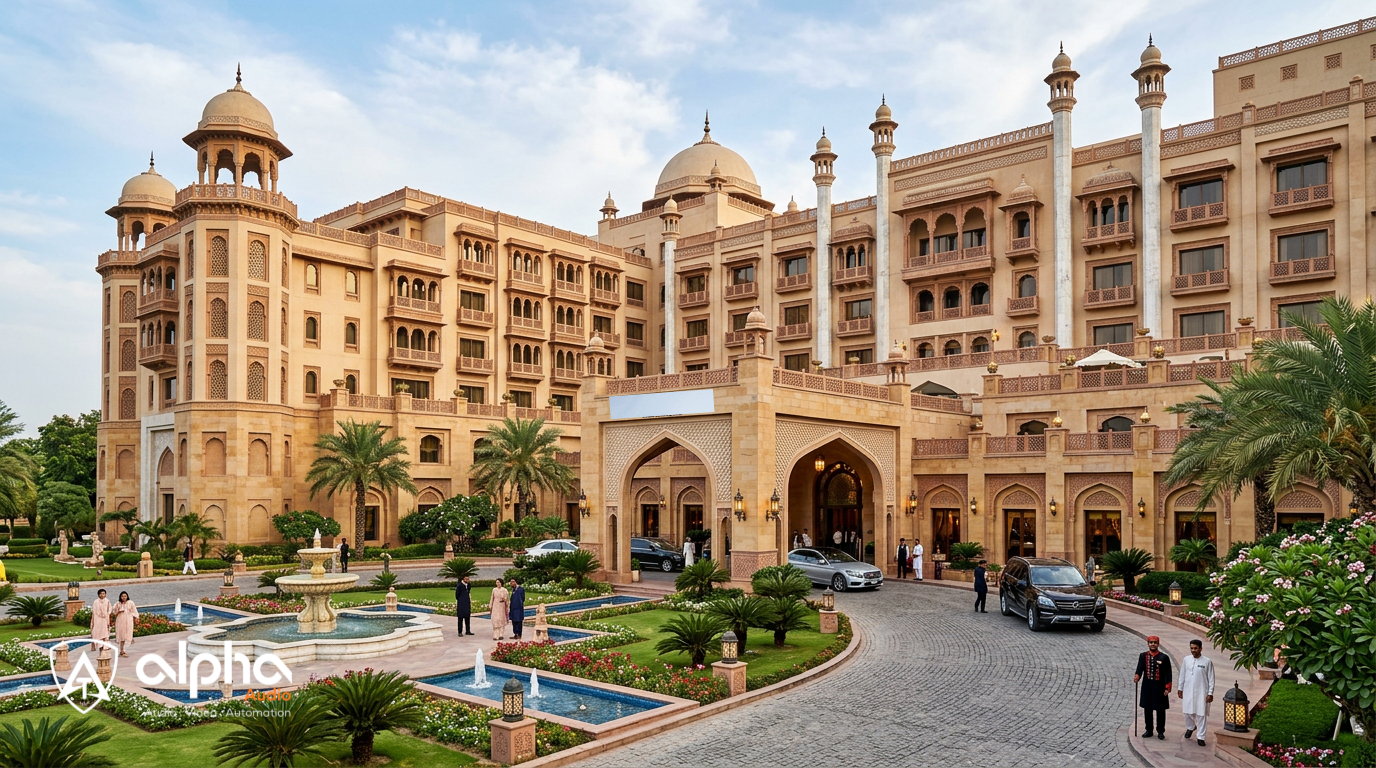
There is a natural extension to this conversation that most Pakistani hotel projects miss entirely: KNX automation. KNX is the international open standard for building automation, used worldwide to control lighting, climate, blinds, security, and audio-visual systems through a single, unified network instead of a dozen disconnected ones. For a five or seven-star hotel, this is not a gadget layer bolted on after construction; it belongs in the same design conversation as the sound strategy, because both systems share the same cabling backbone, the same control logic, and the same guest room infrastructure.
A KNX-automated guest room lets guests dim lighting, adjust air conditioning, close curtains, and select an ambient soundscape from a single panel or app, instead of hunting for three remotes on the nightstand. Engineering and housekeeping teams gain centralized visibility into occupancy, energy use, and equipment status across every floor, which translates into lower utility bills and faster maintenance response. Mood lighting scenes tied to check-in, “Do Not Disturb” indicators, and automatic energy-saving setbacks when a room is unoccupied are now standard expectations at genuine five and seven-star properties internationally.
The reason this belongs in the same blueprint as acoustic planning is structural, not just conceptual. KNX wiring, sound masking cabling, multi-zone audio runs, and PA infrastructure typically share the same ceiling voids, vertical risers, and low-voltage containment. Designing them together during schematic design means one coordinated cabling plan instead of contractors retrofitting around each other’s work later. For developers building five or seven-star properties in Pakistan, pairing a professionally engineered sound strategy with KNX-based room automation is where real competitive differentiation lies: a quieter, more comfortable, more energy-efficient property that meets the integrated smart-building standard today’s luxury travelers already expect.
The Real Cost of Ignoring Acoustics During Construction
Acoustic problems are far cheaper to fix on a drawing than inside a finished building. Once marble is laid, glass is installed, and false ceilings are closed up, retrofitting sound absorption or rerouting cabling for a multi-zone audio system means tearing into finished interiors. A fix that would have cost a few hundred thousand rupees in acoustic panels specified during design can balloon into tens of millions of rupees in rework, lost room-nights, and guest complaints in the interim.
The operational consequences are concrete and recurring. A wedding hall with no sound isolation forces hotels to either cap event volume, losing lucrative banquet bookings to competitors, or accept reviews wrecked by complaints about bass thumping through guest room walls until 1 a.m. A lobby with no architectural treatment becomes a wall of noise where staff repeat themselves and business travelers can’t take calls. Guest rooms without sound masking turn late-night corridor conversations into one-star reviews about “thin walls,” even when the real issue is acoustic design rather than construction quality. A poorly specified PA system during an actual emergency is a safety and liability issue that Pakistani fire codes and hotel safety audits increasingly scrutinize. In an industry where online reputation directly drives occupancy and rate, “the room was noisy” is exactly the kind of review that quietly bleeds revenue for years after opening.
Why “Day One” Matters: Acoustic Design Cannot Be an Afterthought
There is a reason global five-star hotel chains build acoustic consulting into their technical design standards before a single brick is laid. Sound behaves differently depending on room geometry, ceiling height, HVAC duct routing, wall assembly, and furniture density, all decisions made by architects and structural engineers months before interior designers or AV teams are typically consulted. A consultant brought in after drawings are finalized is limited to damage control. One brought in during schematic design can influence decisions that cost nothing extra to build correctly but are nearly impossible to fix later: wall assembly between guest rooms, ceiling plenum design above ballrooms, mechanical equipment placement relative to quiet zones, and cable pathways for a centralized, scalable AV and automation backbone.
For a market like Pakistan, where land and construction costs are already significant and margins on hospitality projects are tightly modeled, this is a cost-efficiency argument, not a luxury consideration. Getting acoustics right at the design stage is the financially smarter path, not just the guest-experience-friendly one.
What International Five-Star Standards Already Assume
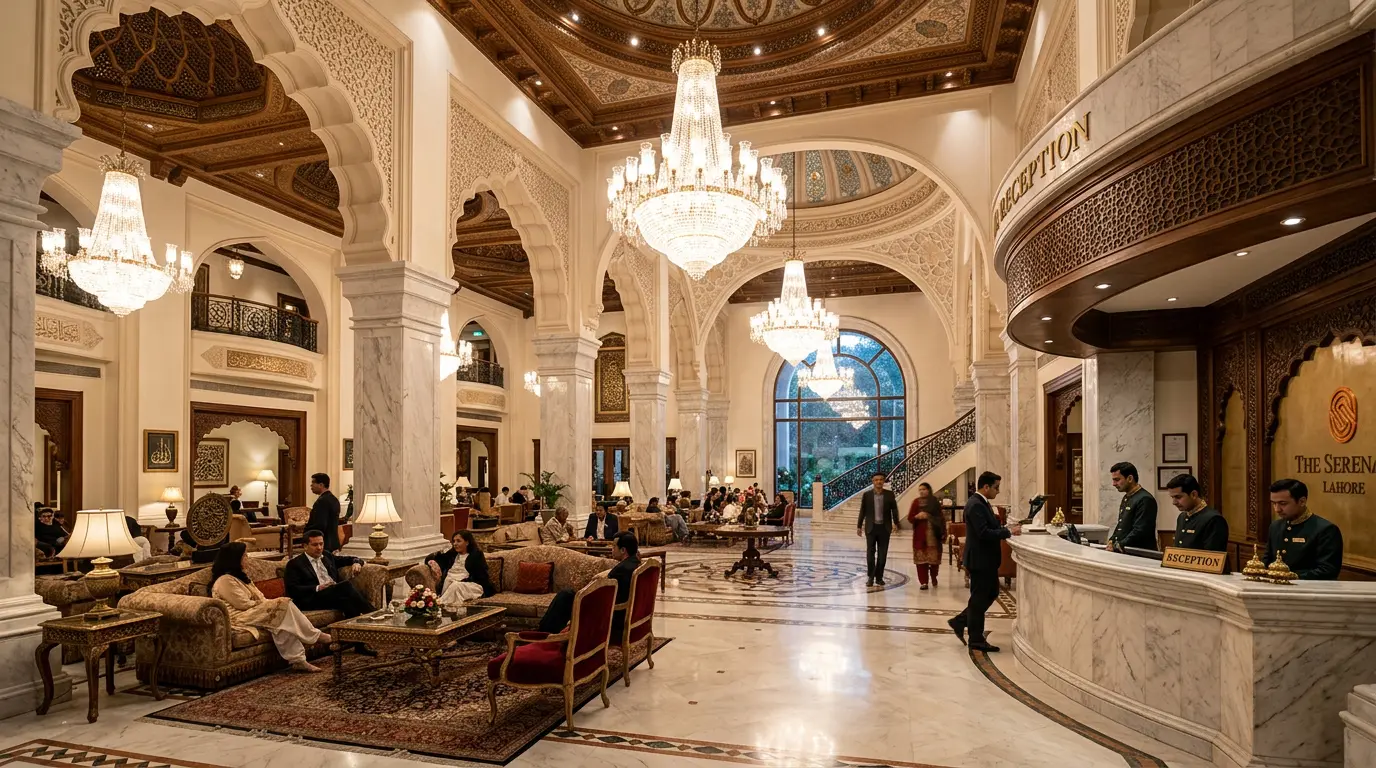
Guests who stay at five-star properties in Dubai, Singapore, Istanbul, or London arrive in Lahore or Karachi with a calibrated expectation: lobbies where ambient sound is engineered, rooms where they cannot hear the corridor, events where the bass stays in the ballroom, and increasingly, rooms where lighting and climate respond intelligently rather than through a wall of switches. When a newly built five-star hotel in Pakistan falls short of that baseline, it is immediately noticeable to the exact international and high-spending domestic clientele the hotel is trying to attract. This matters even more given Pakistan’s growing focus on business tourism, diplomatic hospitality, religious tourism through Islamabad and Lahore, and an expanding MICE sector, guest segments unusually sensitive to acoustic quality and room comfort because their stays revolve around calls, meetings, and presentations.
Building the Business Case: Why Decision-Makers Should Prioritize This Now
For owners, developers, and project directors deciding where to allocate budget during a hotel build, a professional sound strategy delivers returns across several fronts at once. Guest satisfaction and review scores improve when noise complaints, consistently among the top complaint categories in global hotel data, are engineered out from the start instead of apologized for later. Banquet and event revenue increases when ballrooms are acoustically isolated, letting hotels confidently sell late-night weddings and corporate events without disturbing other guests. Brand positioning strengthens because acoustic branding and KNX-driven room comfort are hallmarks of how true luxury brands differentiate themselves from merely expensive ones. Operational efficiency improves because integrated AV, PA, and automation systems are easier to manage and scale than a patchwork of mismatched, disconnected equipment. And regulatory compliance is strengthened, since a properly engineered public address and emergency announcement system is increasingly part of fire safety and hotel licensing audits.
A Practical Roadmap for Developers and Architects
For anyone currently planning or breaking ground on a five-star hotel in Pakistan, the sequence matters as much as the substance. Engage an acoustic and AV consultant during the schematic design phase, alongside the architect and MEP engineer, not after interior finishes are chosen. Commission a room-by-room acoustic brief covering the lobby, guest corridors, ballrooms, restaurants, and spa, since each has different requirements. Specify wall, floor, and ceiling assemblies with acoustic performance built into the structural drawings, not added later as a finishing touch. Design a centralized, scalable AV backbone so background music, paging, and emergency announcements run from one coherent system. Evaluate KNX automation for guest rooms and public areas at the same stage, so lighting, climate, and audio share one cabling plan instead of separate retrofits later. Budget for sound masking in guest corridors and meeting spaces, and plan event-space sound isolation specifically with Pakistan’s wedding and banquet culture in mind, since this single use case drives outsized revenue and outsized complaint risk simultaneously.
The Competitive Window Is Open Right Now
Pakistan’s hotel industry is at an inflection point. New international flags are entering the market, government bodies are courting hospitality investment, and guest expectations are rising with global exposure and social media comparison. The five-star properties that distinguish themselves over the next decade will not just be the ones with the most marble or the tallest atrium. They will be the ones where every sensory layer of the guest experience, sound and smart room comfort included, was deliberately designed rather than left to chance.
A professional sound strategy paired with KNX automation from day one is not an indulgence reserved for hotels with unlimited budgets. It is a disciplined, cost-effective design decision that protects revenue, strengthens brand reputation, satisfies safety requirements, and delivers the seamless guest experience that turns a five-star rating on paper into a five-star reputation in practice. For developers and decision-makers shaping Pakistan’s next generation of luxury hospitality, the question is no longer whether acoustic and automation planning belongs in the budget. It is whether your project will be among the first in the market to get it right from the ground up, or among the many still trying to fix it after the doors have already opened.
Is Your Hotel Project Starting Soon?
The right time to integrate KNX automation, RCF professional audio, and smart LED panels is NOW — before walls go up. Once construction is complete, retrofitting costs 3–5x more and compromises the final result.
Talk to our hotel technology specialists today.
Alpha Audio — Pakistan’s Smart Hospitality Technology Partner
KNX Certified · RCF Authorised · Smart LED Specialists · Nationwide Coverage
Islamabad · Rawalpindi · Lahore · Karachi · Faisalabad · Multan