


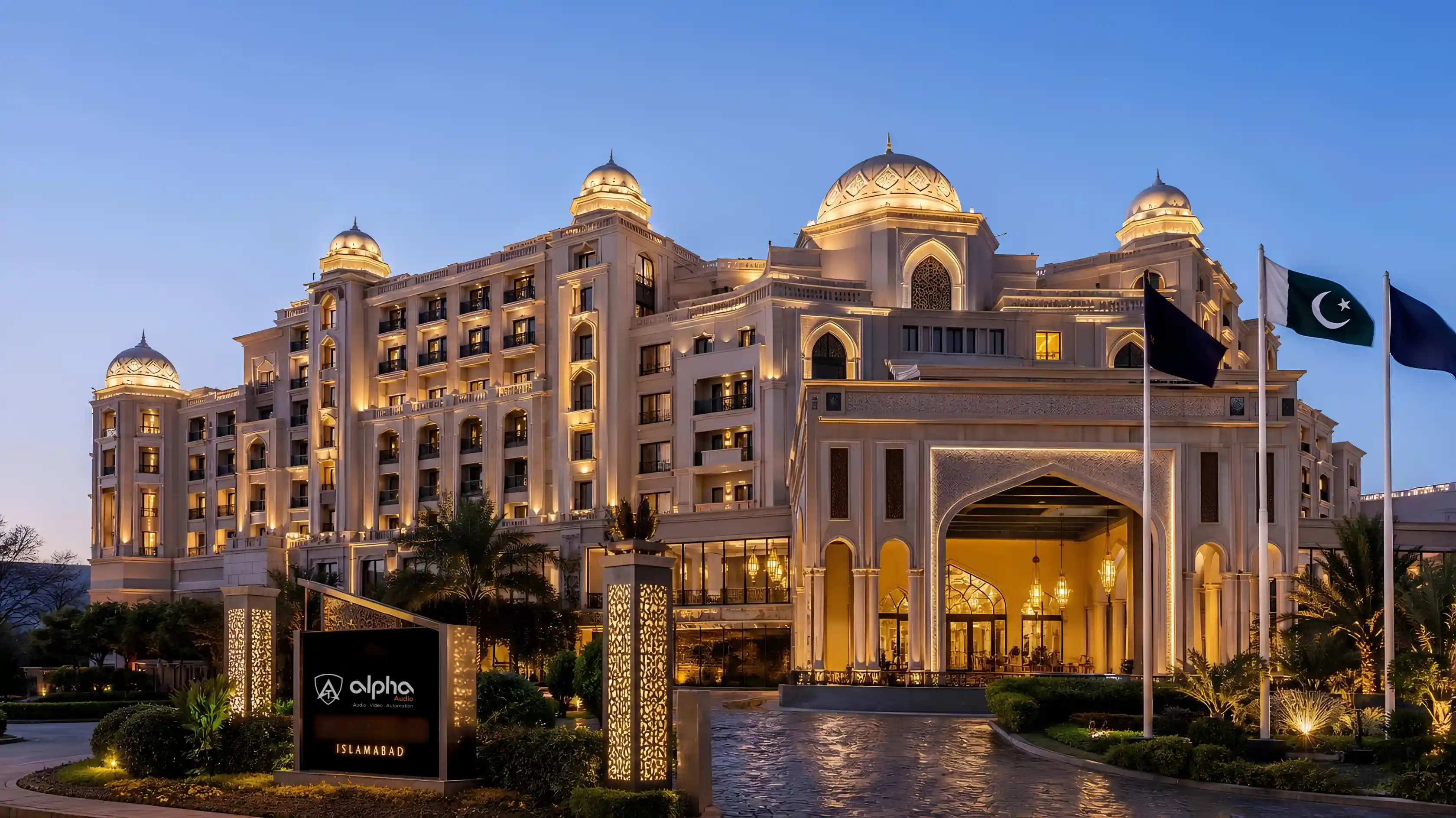
Walk into a five-star hotel room today and flip a switch on the wall, fumble for the AC remote, and awkwardly search for a Bluetooth speaker to set the mood and you’ll immediately notice how outdated that experience feels. Guests in 2026 expect their room to respond to them, not the other way around. This shift is what the hospitality industry now calls the sensor hotel movement, and at the heart of it in Pakistan is one technology standard doing the heavy lifting: KNX automation.
From five-star properties in Lahore and Islamabad to boutique resorts in Murree and Skardu, hotel owners are discovering that lighting, HVAC, audio, and blinds don’t need to be four separate systems fighting for the guest’s attention. They can be one intelligent, sensor-driven network quietly working in the background to create moments that guests remember long after checkout.
This article breaks down what sensor hotels actually are, how KNX automation ties every subsystem into a single brain, how a “Guest Scene” or “Dinner Scene” gets programmed room by room, and why pairing KNX with premium sound solutions like RCF is becoming the gold standard for hospitality projects across Pakistan.
What Exactly Is a “Sensor Hotel”?
A sensor hotel is a property where physical inputs occupancy, motion, daylight levels, temperature, humidity, even the position of a curtain are continuously read by embedded sensors and translated into automated actions. Instead of a guest manually adjusting six different controls, the room reads the environment and adjusts itself, or offers the guest a single, simple choice: a “scene.”
Think of it less as “smart gadgets scattered around a room” and more as a nervous system for the building. Motion sensors detect when a guest enters; light sensors detect whether the sun is too bright; door and window contacts detect if the balcony is open (and shut off the AC accordingly); and all of this data flows into one control network that decides what should happen next.
The result is a room that:
- Turns on soft ambient lighting the moment a guest walks in after 9 PM, but bright task lighting during the day
- Lowers blinds automatically when direct sunlight hits a certain sensor threshold, protecting furniture and reducing glare
- Cools or warms the room to a preset comfort temperature before the guest even arrives, based on check-in time
- Silences music and dims lights automatically as an “Away” scene when the door key card is removed
None of this requires the guest to learn a complicated app or remember which switch does what. It requires one integrated automation backbone and that’s exactly the role KNX plays.
KNX Automation: The Single Network Behind Every Subsystem
KNX is an open, internationally standardized (ISO/IEC 14543) protocol for building automation. Unlike proprietary smart home ecosystems that often lock hotels into a single vendor, KNX allows lighting dimmers, HVAC actuators, blind motors, audio interfaces, sensors, and touch panels — from many different manufacturers — to speak the same language over a single bus network.
For a hotel operator, this interoperability is the real value. A property doesn’t need five separate control apps or five separate maintenance contracts for lighting, climate, curtains, audio, and security. Everything communicates over the same KNX bus, and everything can be centrally programmed, monitored, and adjusted from one system.
Why KNX Fits Pakistani Hospitality Specifically
Pakistan’s hotel and hospitality sector faces a few realities that make KNX especially attractive:
- Power fluctuation resilience – KNX’s low-voltage bus wiring is far less susceptible to the kind of surges and outages that can damage more delicate proprietary smart-home electronics, which matters in cities where load-shedding and voltage instability are still common.
- Scalability across large properties – Whether it’s a 40-room boutique hotel or a 300-room five-star tower, KNX scales linearly. Adding a new wing or floor doesn’t mean re-engineering the whole system.
- Long-term serviceability – Because KNX is an open standard with certified installers, hotels aren’t dependent on a single company staying in business forever to get spare parts or support.
- Energy savings – With HVAC and lighting tied to occupancy and daylight sensors, hotels report meaningful reductions in energy wastage — a critical concern given Pakistan’s rising utility costs.
- Guest-facing “wow factor” – In a competitive hospitality market where properties are increasingly judged on Instagram-worthy tech experiences, a genuinely automated, sensor-driven room is a differentiator that guests talk about.
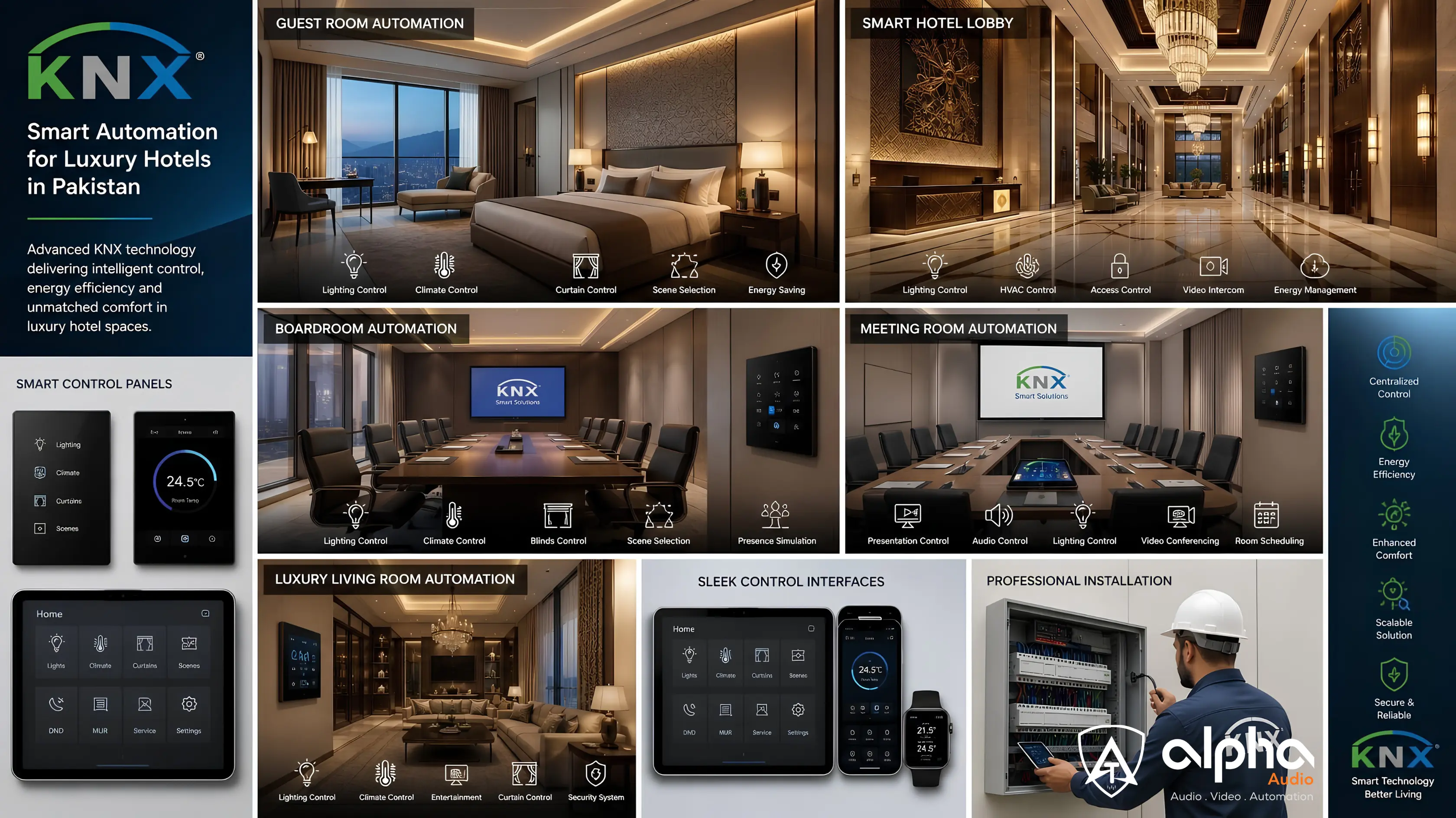
The Four Pillars of a KNX-Driven Hotel Room
1. Lighting
KNX-controlled lighting isn’t just “on and off.” Every fixture from cove lighting to bathroom vanity lights to bedside lamps — can be dimmed, color-tuned, and grouped into scenes. A single button press (or sensor trigger) can shift an entire room’s lighting mood in under a second.
2. HVAC (Heating, Ventilation, and Air Conditioning)
KNX thermostats and actuators tie directly into occupancy sensors and window/balcony contacts. If a guest opens the balcony door, the AC pauses automatically rather than wasting energy cooling the outdoors. If the room is unoccupied for an extended period, the system can shift into an energy-saving standby mode, then pre-condition the room again shortly before the guest is expected back.
3. Blinds and Curtains
Automated blinds respond to sun position, time of day, and manually triggered scenes. A “Sleep” scene can close blackout curtains fully; a “Morning” scene can gently open them at a scheduled wake-up time instead of a jarring alarm.
4. Audio
This is where premium sound integration and brands like RCF enter the picture. KNX handles the control logic (which zone plays what, at what volume, triggered by which scene), while RCF’s professional-grade speakers and amplifiers deliver the actual audio experience. RCF is widely respected in commercial and hospitality audio for its clarity, durability, and consistent performance across different acoustic environments from compact hotel rooms to open-plan lobbies and rooftop dining areas.
Together, KNX and RCF form a natural pairing: KNX is the intelligent switchboard, and RCF is the voice.
Programming a “Guest Scene”: How It Actually Works
A “scene” in KNX terms is simply a pre-programmed combination of settings across multiple subsystems, triggered by a single command a button press, a sensor event, or a scheduled time.
Here’s what a basic “Welcome” Guest Scene looks like when a guest checks in and enters their room for the first time:
- Lighting: Entryway lights fade up to 60% warm white; bedside lamps set to 40%; bathroom light activates only if motion is detected there
- HVAC: Room temperature already pre-set to 23°C, adjusted 30 minutes before scheduled check-in based on front-desk system integration
- Blinds: Sheer curtains open partially to let in natural light, blackout curtains remain retracted
- Audio: A soft instrumental playlist plays at low volume (around 20%) through RCF in-ceiling speakers, automatically fading out after 10 minutes or when the guest manually adjusts it
All of this happens the instant the guest’s key card is inserted into the wall-mounted presence switch no manual configuration needed from the guest.
The “Dinner Scene”: A Signature Hospitality Moment
Where KNX truly shines for hotels is in scenes built for specific guest experiences — and the Dinner Scene is one of the most requested by five-star and boutique properties in Pakistan, particularly for suites, private dining rooms, and honeymoon packages.
A Dinner Scene might be triggered via an in-room touch panel, a voice command integrated through a KNX-compatible gateway, or a scheduled time if pre-booked through the hotel’s concierge app. Here’s a sample programming logic:
Trigger: Guest selects “Dinner” on the in-room KNX touch panel, or it’s scheduled for 8:00 PM as part of an in-room dining package.
Lighting Response:
- Main ceiling lights dim to 15%
- Warm-toned pendant or table lighting rises to 70%
- Accent wall lighting shifts to a warmer color temperature (around 2700K)
- Bathroom and closet lights remain off unless triggered by motion
HVAC Response:
- Temperature nudges down by 1–2°C to compensate for the added warmth of ambient lighting and food service equipment
- Fan speed set to “silent” mode to avoid disrupting conversation
Blinds Response:
- Curtains partially close for privacy while leaving a view of the skyline or garden, depending on room orientation
- If it’s a rooftop or balcony dinner setup, exterior blinds retract fully to showcase the view
Audio Response (RCF Integration):
- A curated dinner playlist (soft jazz, acoustic, or the guest’s pre-selected genre) plays through RCF ceiling or in-wall speakers
- Volume is capped at a “conversation-friendly” level typically 25–30% of max output calibrated during installation so speech remains clear over the music
- If the dinner is on a balcony, RCF outdoor-rated speakers activate instead of the indoor zone, with the indoor zone automatically muting to avoid overlap
Optional Add-On: Some properties link the Dinner Scene to a “Do Not Disturb” logic simultaneously dimming the hallway indicator light outside the door and silencing room service notification chimes for the duration of the reservation window.
This entire sequence lighting, temperature, blinds, and multi-zone audio executes in under two seconds from a single trigger. That’s the essence of KNX automation: complexity hidden behind simplicity.
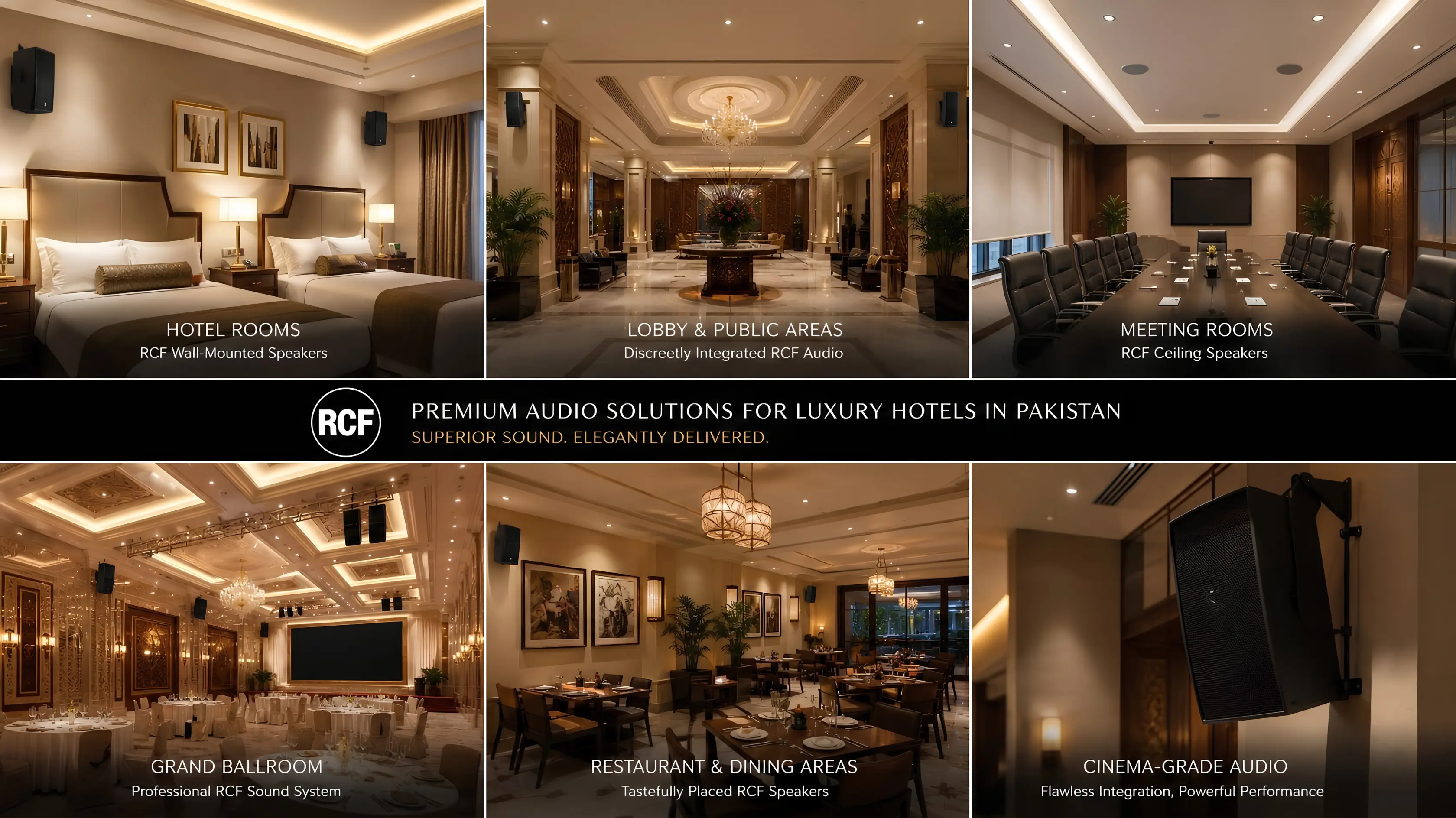
Why RCF for Premium Hotel Sound
Not every speaker system can survive the demands of a hospitality environment — long operating hours, variable humidity in bathrooms and pool areas, and the need for consistent audio quality across dozens or hundreds of rooms without constant maintenance. RCF has built a strong reputation in commercial and hospitality installations because of:
- Engineering built for continuous commercial use, not just consumer living rooms
- Consistent sound reproduction across different zones — lobby, restaurant, spa, guest rooms — without needing different brands for different areas
- Durability in humid or semi-outdoor environments, useful for poolside decks, rooftop dining, and spa areas common in Pakistani hospitality projects
- Compatibility with KNX-based control systems, allowing volume, source selection, and zone activation to be managed through the same interface as lighting and climate
When paired with KNX’s scene logic, RCF speakers stop being “just background music” and become an active part of the guest experience — timed, zoned, and mood-matched precisely to whatever moment the hotel is trying to create.
Beyond the Room: Sensor Automation Across the Property
While guest rooms get the most attention, KNX automation extends naturally to:
- Corridors and lobbies occupancybased lighting that dims in low-traffic hours to save energy without feeling “off”
- Conference and banquet halls one-touch scene changes between “Presentation Mode” (dimmed lighting, projector-friendly) and “Networking Mode” (bright, upbeat audio)
- Spa and wellness areas synchronized lighting, temperature, and RCF ambient audio for treatment rooms
- Rooftop and outdoor dining – weatherproof automation for blinds, misting systems, lighting, and audio zones
This property-wide consistency is what separates a genuinely “smart” hotel from one with a few disconnected gadgets.
The Business Case: Why Hotel Owners in Pakistan Are Investing in KNX
Beyond the guest experience angle, there’s a clear operational and financial case:
- Energy cost reduction through occupancy-based HVAC and lighting control — often cited as one of the largest recurring operational expenses for hotels
- Reduced maintenance complexity since one certified KNX integrator can service lighting, HVAC control, and audio triggers instead of coordinating three or four separate vendors
- Higher guest satisfaction scores and repeat bookings, particularly among business travelers and premium leisure guests who notice and appreciate seamless technology
- Future-proofing, since KNX’s open standard means new devices and sensors can be added over time without ripping out the existing backbone
- Marketing differentiation in a hospitality market where “smart room” and “automated suite” are becoming genuine selling points on booking platforms
For developers planning new hotel builds or renovating existing properties across Lahore, Islamabad, Karachi, and northern tourist destinations, KNX automation paired with premium audio brands like RCF isn’t a luxury add-on anymore it’s quickly becoming the expected baseline for any property competing at the four- or five-star level.
Final Thoughts
The sensor hotel trend isn’t about flashy gadgets — it’s about designing rooms that respond intelligently to real guests in real moments, whether that’s a quiet arrival late at night or a carefully orchestrated Dinner Scene meant to make an anniversary or business dinner feel effortless. KNX automation provides the unifying backbone that ties lighting, HVAC, blinds, and audio into one coherent system, while premium sound partners like RCF ensure that the audio layer of the experience is as polished as everything else.
As more Pakistani hospitality brands look to differentiate themselves, the properties investing in this kind of integrated automation today are the ones guests will be talking about and rebooking tomorrow.
Contact Alpha Audio today
+92 308 4319219 | info@alphaaudio.com.pk | alphaaudio.com.pk
Visit us: Plaza No. 28, Phase 6 DHA, Lahore, Punjab