

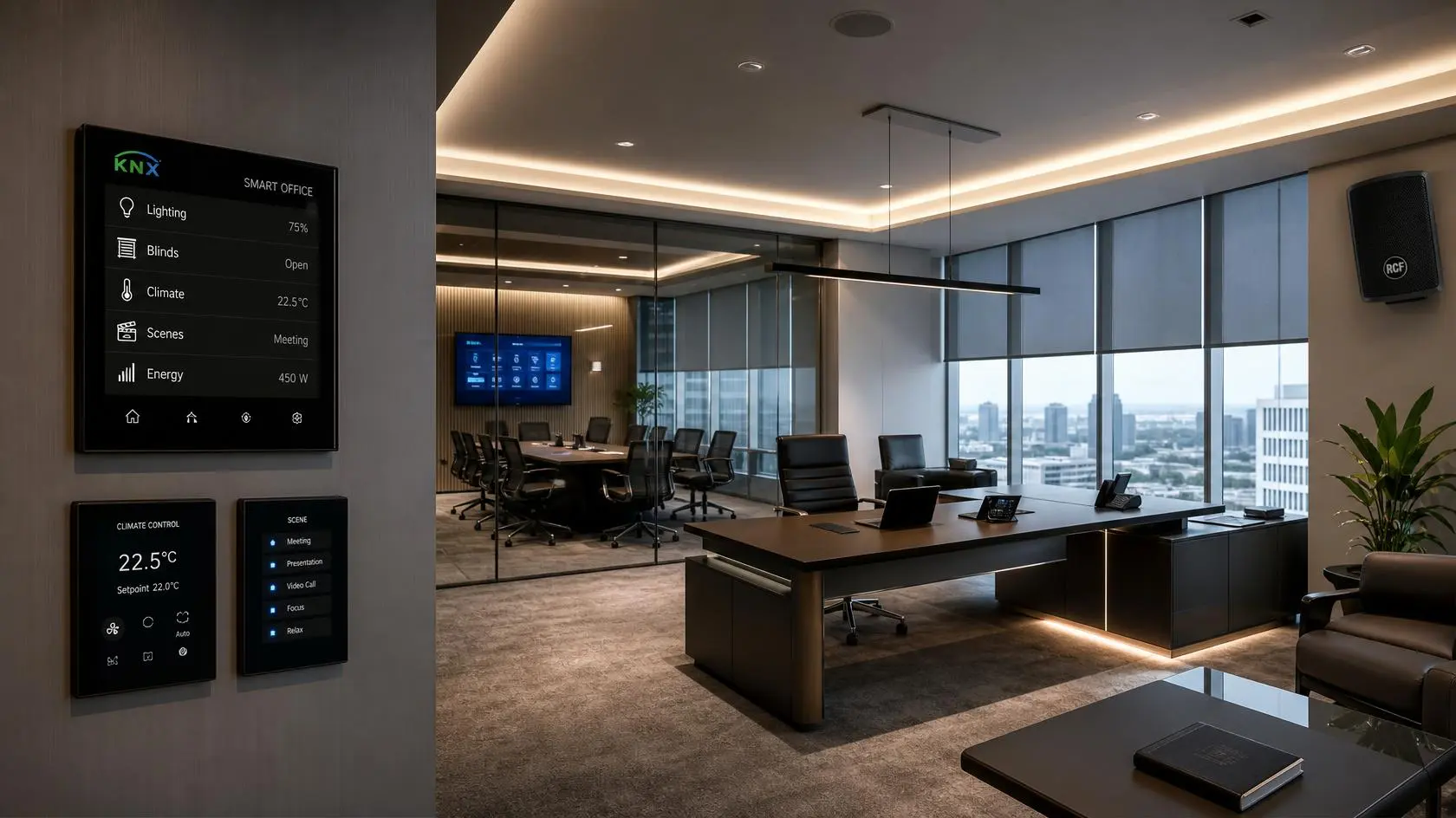
Your Competitors Are Already Automating Their Offices Are You?
Walk into any modern office tower in Lahore, Karachi, or Islamabad today and you’ll notice something: the lights adjust themselves, the AC doesn’t run in empty conference rooms, and employees badge in without a security guard writing names in a register. While you’re still manually flipping switches and paying for electricity nobody used, forward-thinking businesses around you are quietly cutting costs, improving employee experience, and freeing up management time all through smart office automation.
The uncomfortable truth for 2026 is this: smart offices are no longer a “nice-to-have” for multinational corporations with unlimited budgets. They’ve become a competitive necessity, especially in a country like Pakistan where electricity tariffs keep climbing and operational efficiency directly impacts your bottom line. If your office is still running on switches, timers, and guesswork, you’re not just behind on technology you’re leaving money on the table every single month.
The Real Problem: “Smart Office” Doesn’t Mean Expensive Gadgets
Ask ten business owners in Pakistan what a “smart office” is, and you’ll likely get ten different and mostly wrong answers. Many picture flashy voice assistants, robotic receptionists, or Silicon Valley-style tech installations that cost millions of rupees and deliver little real value.
This misconception is exactly why so many small and medium-sized businesses in Pakistan avoid office automation altogether. They assume it’s:
- Too expensive for a mid-sized company
- Only relevant for large corporate offices
- A luxury feature rather than a productivity tool
- Complicated to install and maintain
The result? Businesses keep paying inflated electricity bills, dealing with security gaps, and losing productive hours to manual, repetitive tasks all because they never understood that smart office technology is fundamentally about efficiency, not extravagance.
A smart office isn’t about impressing visitors with gadgets. It’s about making your workplace run smarter, cheaper, and safer automatically.
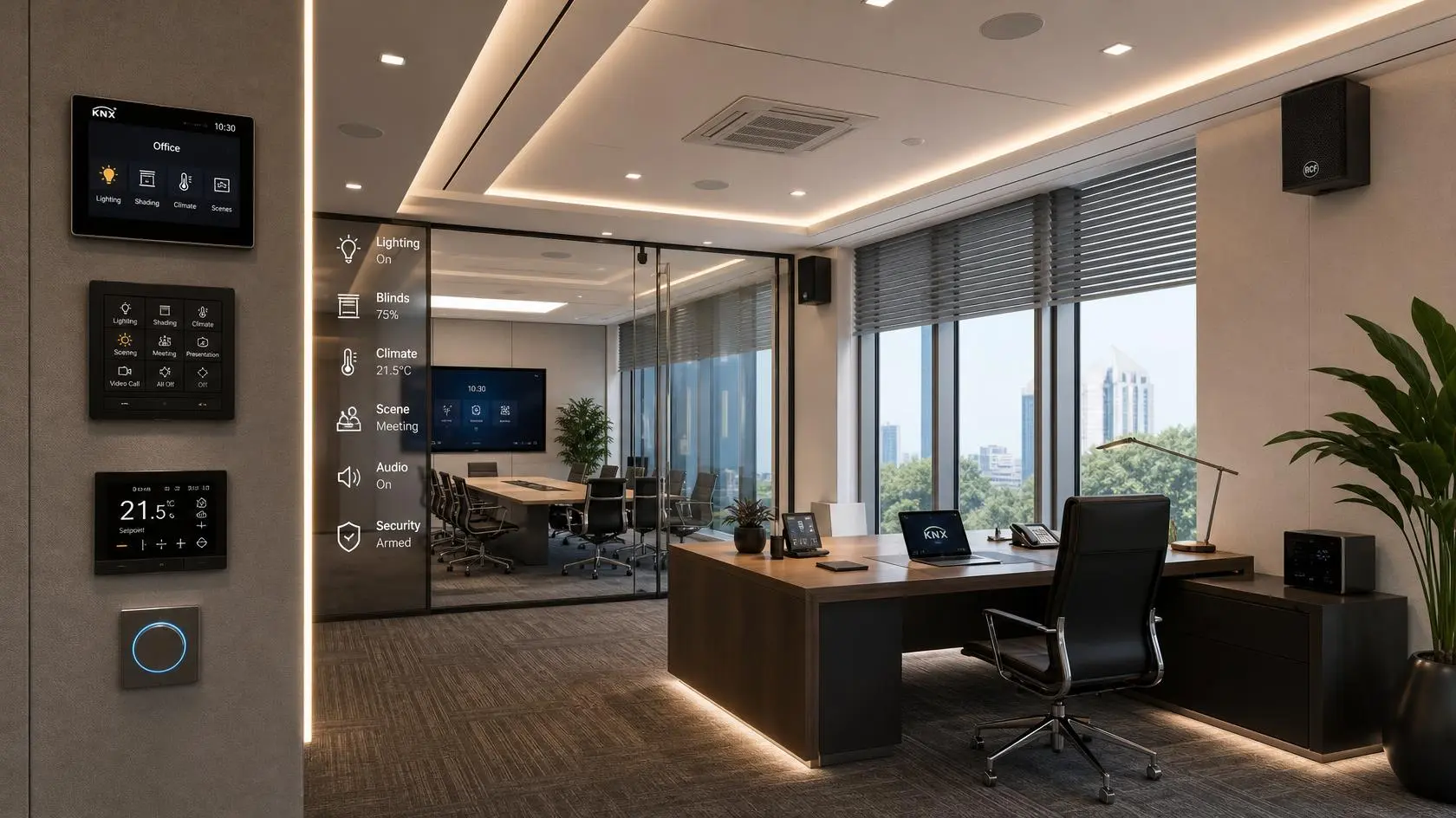
So, What Actually Is a Smart Office?
A smart office is a workplace where core building systems — lighting, climate control, audiovisual (AV) equipment, and access control — are connected, automated, and managed through a single integrated platform, rather than operated manually and independently.
The key word here is integration. Individually, a motion-sensor light or a smart thermostat is just a gadget. Together, connected through one system that talks to each other, they become a smart office. Here’s what that actually looks like in practice:
1. Automated Lighting
Instead of employees (or the office boy) manually switching lights on and off, sensors detect occupancy and daylight levels, adjusting brightness automatically. Corridors, storerooms, and meeting rooms light up only when someone is actually there, and dim or shut off automatically when they’re not.
2. Smart Climate Control (HVAC)
Air conditioning and heating systems are scheduled and zone-controlled based on real occupancy and time of day, rather than running at full blast across an entire floor regardless of whether three people or thirty are present. In Pakistan’s summer heat, this is one of the highest-impact automations a business can make, given how much of a typical office electricity bill goes toward cooling.
3. Integrated AV Systems
Conference rooms that automatically configure the right camera angle, microphone, and display the moment a scheduled meeting begins — no more wasting the first ten minutes of every client call fumbling with cables and remotes.
4. Centralized Access Control
Biometric or card-based entry systems replace registers and physical keys, giving management real-time visibility into who enters and exits the building, restricting access to sensitive areas, and creating an audit trail automatically.
5. One Unified Platform
The real “smart” in smart office comes from tying all of the above into a single dashboard or app, so that a facilities manager — or even the business owner from their phone — can monitor and control the entire office environment from one place, and set automated “scenes” (e.g., an “End of Day” mode that locks doors, shuts down AC, and turns off all non-essential lighting simultaneously).
This is the definition that matters for business owners: a smart office is not a pile of individual devices — it’s a connected system built to reduce waste, reduce risk, and reduce manual overhead.
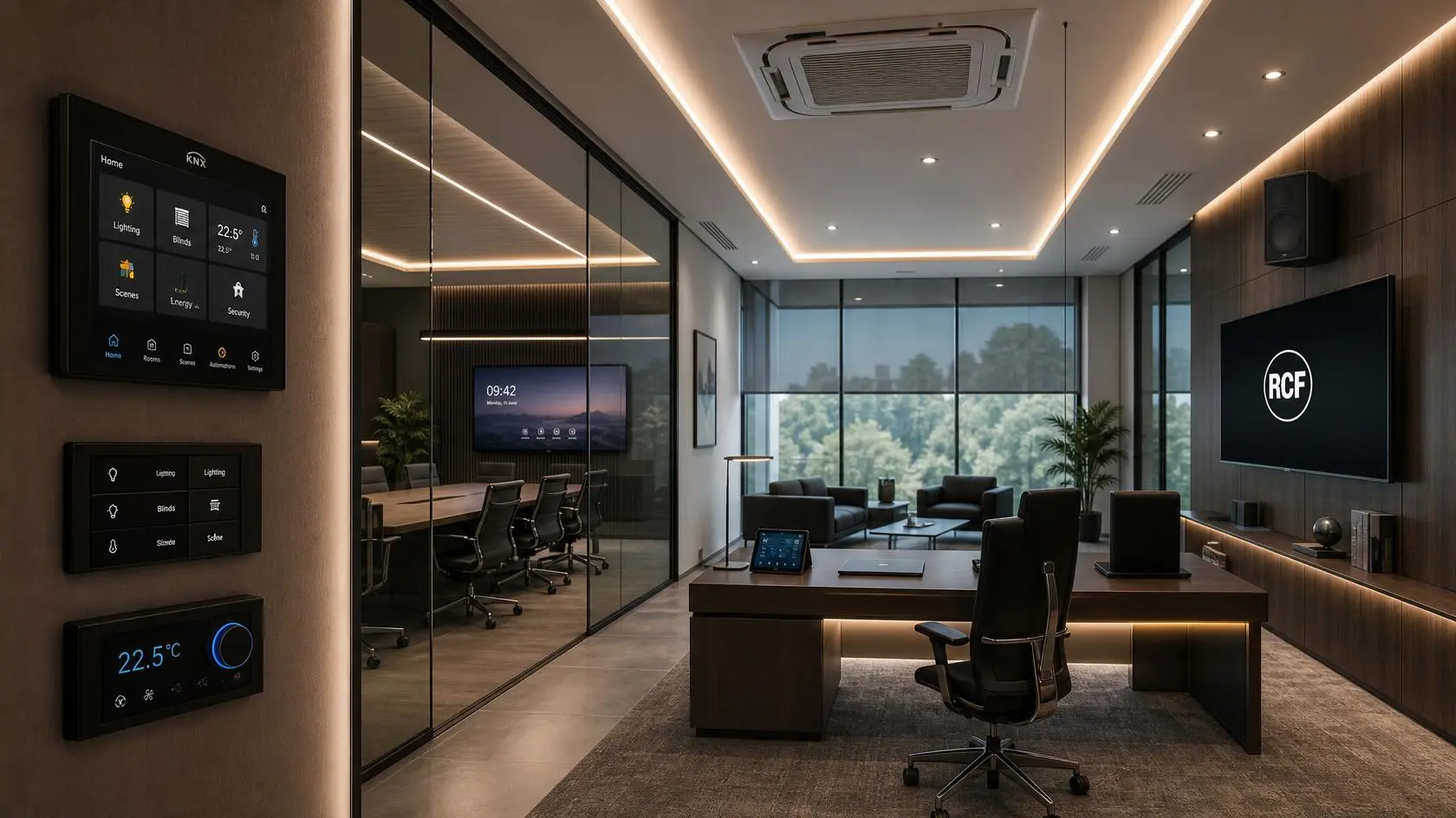
The Proof: What Businesses Actually Gain From Office Automation
Skeptical business owners are right to ask for evidence before investing. Fortunately, the data on smart office adoption is now extensive, and it consistently points in one direction: measurable savings and productivity gains.
Energy costs drop significantly. Businesses that adopt smart office technologies report an average 25% reduction in energy costs, largely driven by automated lighting, smart HVAC, and IoT-enabled monitoring that cut down on waste. Some real-world deployments go further smart HVAC systems have cut energy use by up to 50%, while occupancy-based lighting schedules have reduced lighting costs by roughly 25% in practice.
The savings compound with better space and resource management. Broader workplace automation research shows organizations achieving energy cost reductions of 35–50% through automation, alongside space efficiency gains of up to 40% by using occupancy analytics to identify underused areas.
This isn’t a passing trend — it’s where the market is headed. The global smart office market was valued at roughly USD 55.6 billion in 2025 and is projected to grow at a compound annual rate of about 10% through 2034, driven largely by rising energy costs, hybrid work patterns, and growing pressure on businesses to cut operational overhead while improving productivity. Industry analysts also note that corporate real estate and facilities teams have rapidly shifted toward AI-driven automation pilots — up from under 5% of teams in 2023 to 92% now actively planning them, and that the highest returns come not from flashy gadgets but from occupancy data and space analytics that inform smarter day-to-day decisions.
Why this matters even more in Pakistan. Local electricity tariffs have continued to climb, with NEPRA’s national average uniform tariff set at roughly Rs 33.38 per unit as of January 2026, and commercial users on some DISCOs facing rates that climb even higher during peak daytime business hours. For offices running AC units, lighting, and equipment across long working hours, automated climate and lighting control isn’t a marginal saving, it’s a direct, recurring reduction on one of the largest line items in your monthly overhead. Combine that with rupee volatility and rising fuel-adjustment charges, and the case for automation in Pakistan is arguably stronger than in markets with stable, low-cost power.
Beyond energy, there are productivity and security benefits that are harder to put a single number on but matter just as much day to day: fewer minutes lost to manual AV setup before meetings, fewer security blind spots from paper visitor logs, and less administrative burden on office managers who no longer need to physically check and adjust systems room by room.
Common Objections And Why They Don’t Hold Up
“We’re too small for this.” Smart office systems are modular. You don’t need to automate an entire 50,000 sq ft building on day one. Many Pakistani businesses start with smart lighting in high-traffic areas or a single automated AC zone and expand from there as the savings prove themselves.
“It’s too complicated to maintain.” Modern systems are designed for remote monitoring and cloud-based control. Most vendors offering smart office solutions in Pakistan also provide integration with your existing AC units and lighting fixtures, meaning you don’t need to rip out and replace your entire infrastructure.
“We already control costs manually.” Manual control depends entirely on employee discipline someone has to remember to turn things off. Automation removes that dependency entirely, which is exactly why the savings from automated systems are consistently higher than those achieved through policy and reminders alone.
Is Your Office Actually “Smart-Ready”?
Before investing in any automation system, the smartest first step isn’t buying equipment it’s understanding exactly where your office is losing money and efficiency right now. Every office is different: some are bleeding money on unnecessary cooling, others have security gaps from outdated access systems, and many simply don’t know where to start.
That’s exactly the gap a smart-office readiness audit is designed to close.
Ready to Find Out How Much Your Office Could Save?
We’re offering a free smart-office readiness audit for businesses in Pakistan. In this no-obligation assessment, we’ll evaluate your current lighting, climate control, AV setup, and access control systems, and show you exactly where automation could reduce your costs and improve your day-to-day operations with real numbers specific to your office, not generic industry averages.
Your competitors are already automating. The only question left is how much longer you’ll wait to find out what it could do for your business.
How much does it cost to make an office "smart" in Pakistan?
Costs vary widely depending on office size and which systems you automate first. Starting with lighting or a single HVAC zone is typically the most affordable entry point, with many businesses recovering their investment through electricity savings within one to two years.
Can smart office systems work with our existing AC and lighting?
In most cases, yes. Intelligent control modules can be retrofitted onto existing AC units and lighting fixtures, meaning you don’t need a complete infrastructure overhaul to get started.
Is a smart office only useful for large corporate offices?
No. Small and medium-sized businesses often see the fastest return on investment, since even modest automation — like occupancy-based lighting or scheduled climate control — directly reduces recurring electricity costs relative to their overall overhead.
What's the difference between a "smart building" and a "smart office"?
Smart buildings focus on infrastructure-level systems like HVAC optimization and structural monitoring. Smart offices focus on the day-to-day human layer how employees use lighting, climate, meeting rooms, and access though the two are increasingly designed to work together.
+92 308 4319219 | info@alphaaudio.com.pk | alphaaudio.com.pk
Visit us: Plaza No. 28, Phase 6 DHA, Lahore, Punjab