


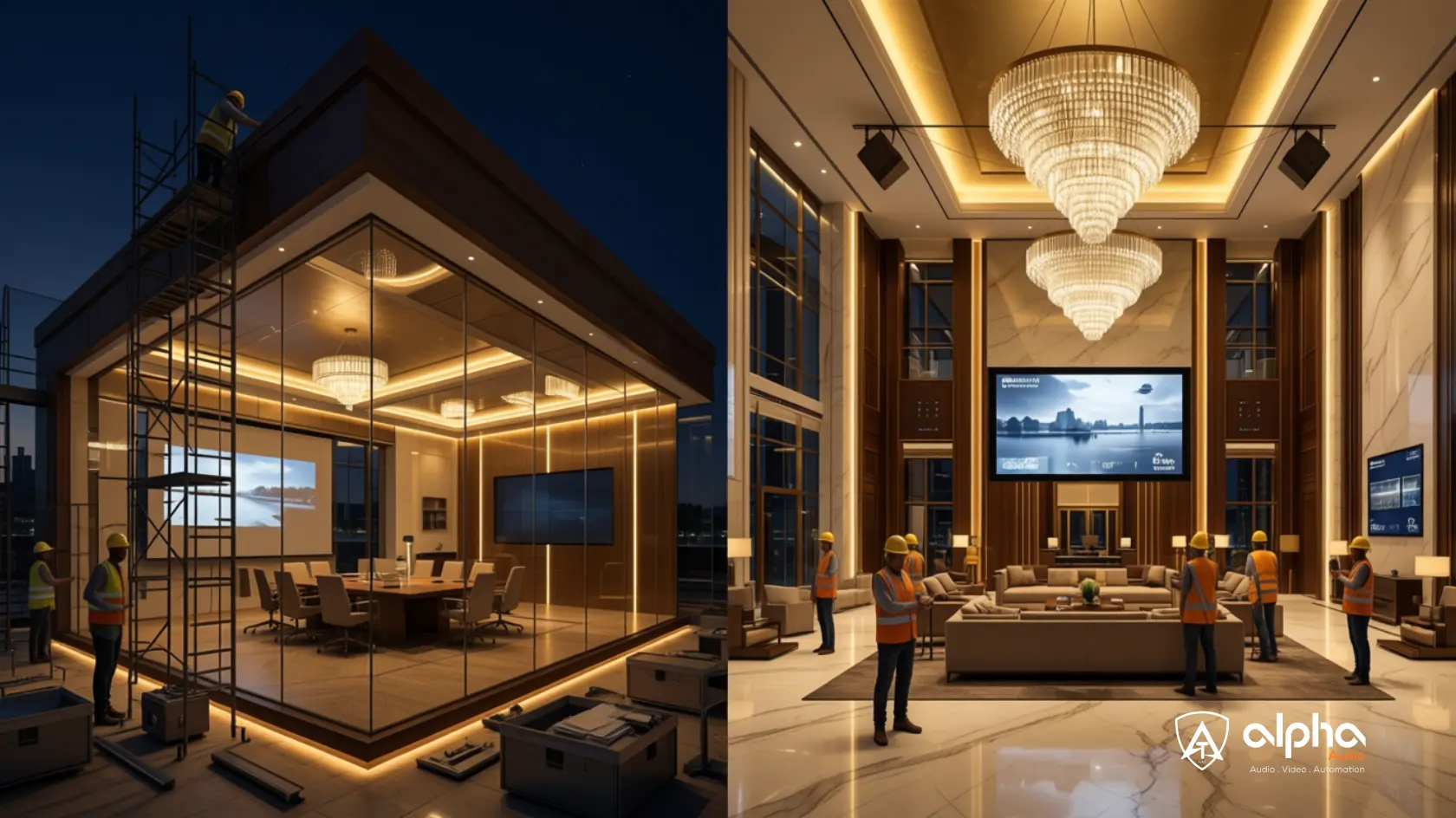
Walk through any major development pitch in Lahore, Islamabad, or Karachi right now and you’ll hear the same script: branded residences, “live-work-play” ecosystems, concierge services, smart security, rooftop lounges, five-star finishes. Developers are competing on marble, glass facades, and imported fittings. What almost none of them are competing on and what almost none of the coverage is talking about is the audio-visual and technology backbone that determines whether any of that lifestyle promise actually works once people move in, or once a boardroom, ballroom, or business hub tries to host a real event.
That gap is about to matter a lot more than most developers realize, because two trends are converging at exactly the same time: a genuine boom in Pakistan’s highend residential and mixed-use real estate, and a parallel and much less discussed expansion of the country’s meetings, incentives, conferences, and exhibitions (MICE) sector, which industry estimates put on a growth trajectory approaching 15% annually. Neither of these can be delivered credibly without serious AV and low-voltage infrastructure. Right now, almost nobody is building for it early enough.
The Boom Is Real and It’s Vertical
Pakistan’s luxury property market has shifted decisively over the last few years. What used to be defined by standalone housing schemes has given way to integrated, vertical developments that bundle residential towers, commercial space, hospitality, and retail into single master-planned ecosystems. Projects across DHA Islamabad, Gulberg in Lahore, and Karachi’s Clifton and Scheme 33 corridors are increasingly built around high-rise living, branded residences, and mixed-use “live-work-play” models designed to appeal to both resident buyers and the overseas Pakistani diaspora, who are pouring capital into projects that promise international-standard delivery and lifestyle parity with Dubai or London.
This is no longer a story about plots and files. It’s a story about buildings that need to function like premium products smart homes with integrated control, security systems that actually talk to each other, and shared amenity spaces (gyms, lounges, business centres, event halls) that are expected to perform at a five-star hotel standard. That expectation carries a technology cost that most project budgets still treat as an afterthought, bolted on during fit-out instead of planned into the architecture.
The MICE Opportunity Nobody’s Wiring For
Layered on top of the property boom is Pakistan’s expanding events and business-tourism economy. As mixed-use developments proliferate, so do the conference centres, banquet halls, corporate boardrooms, and hospitality venues meant to serve them — the physical infrastructure that any credible MICE industry needs to function. Globally, the MICE sector has been growing at a consistently strong clip over the past several years, and Pakistan’s segment is being positioned by industry watchers as one of the faster-growing corners of that market, with projected growth approaching 15% CAGR as corporate travel, incentive programs, and large-scale conferences find a home in the country’s new commercial and hospitality developments.
That’s a meaningful opportunity but only if the venues behind it can actually deliver. A “world-class conference facility” is not a marketing phrase; it’s a technical specification. It means:
- Video conferencing systems that hold a stable, high-definition connection with international counterparts without dropouts
- Distributed audio that reaches every seat in a ballroom evenly, without dead zones or feedback
- Room acoustics engineered — not just decorated — to handle speech intelligibility at scale
- Centralized AV control systems that a hotel’s own staff can operate without a dedicated technician on call
- Structured, future-proofed cabling that doesn’t need to be ripped out the moment a new display standard or codec arrives
Most developers are planning for the marble and the chandeliers. Very few are planning, at the architectural stage, for the conduit runs, rack rooms, acoustic treatment, and control infrastructure that make any of the above possible. That’s the gap.

Why the Gap Exists
It isn’t a lack of ambition it’s a sequencing problem. AV and technology infrastructure in Pakistan’s construction industry is still treated, almost universally, as a late-stage decision. Electrical contractors run generic conduit. Interior designers finalize ceiling and wall finishes. Only after the shell is largely complete does anyone start asking where the screens, speakers, and control panels are actually going to go by which point, retrofitting proper cabling paths, acoustic isolation, or equipment rooms is expensive, disruptive, or simply no longer possible without visible compromise.
The result is predictable: luxury developments that look flawless in the brochure but underperform the moment real technology gets installed. Home cinemas with washed-out picture because nobody planned for light control. Boardrooms where the video call keeps freezing because the network backbone was never sized for it. Banquet halls with audio that sounds fine empty and unintelligible full, because acoustic modeling was never part of the design brief.
For a market that’s explicitly selling international-standard living and international-standard event hosting, that’s a real credibility risk and a real opportunity for whoever solves it properly.
Where Alpha Audio Fits In
This is precisely the gap Alpha Audio is built to close not as a vendor brought in after the fact to hang a few speakers and screens, but as a design-stage AV and technology integration partner working alongside architects, developers, and hospitality operators from the earliest planning phase.
That means:
- Pre-construction AV design working from architectural drawings to plan cabling routes, equipment rooms, and acoustic treatment before walls go up, not after
- Structured, future-proof infrastructure cabling and network backbones sized for where AV technology is heading, not just what’s available today
- Boardroom and conference-grade systems video conferencing, presentation, and control setups built to the same reliability standard as any international business hub
- Hospitality and event-space AV distributed sound, acoustic engineering, and centralized control for ballrooms, banquet halls, and multi-purpose venues designed to actually host the MICE-driven business Pakistan is trying to attract
- Smart residential integration home cinema, whole-home audio, and automation systems built into luxury residential towers as a core part of the buyer experience, not a post-handover upgrade
The developers who get ahead of this — who bring AV planning into the architectural conversation instead of the punch-list — are the ones whose properties will actually deliver on the “world-class” positioning they’re marketing. The rest will spend the next several years quietly retrofitting buildings that were never built to carry the technology their occupants expect.

The Real Opportunity
Pakistan doesn’t have an infrastructure problem in the sense of not building enough. It has a sequencing problem: technology infrastructure arriving last, when it should be arriving first. As the luxury real estate boom accelerates and the MICE sector chases double-digit growth, the developments that differentiate themselves won’t be the ones with the tallest towers or the most imported marble they’ll be the ones where the audio-visual experience matches the promise on the brochure, because it was engineered in from day one.
That’s the conversation the industry isn’t having yet. It’s the one Alpha Audio is ready to have with every architect, developer, and hospitality group building Pakistan’s next generation of luxury and business spaces.
Contact Alpha Audio today
+92 308 4319219 | info@alphaaudio.com.pk | alphaaudio.com.pk
Visit us: Plaza No. 28, Phase 6 DHA, Lahore, Punjab
Audio Quotation
Video Quotation
Automation Quotation