

The Problem: Most Business Owners Misunderstand What “Smart Office” Really Means
Here’s where most companies get stuck. Ask a business owner in Pakistan what a smart office is, and you’ll usually hear one of two answers:
- “It’s just fancy gadgets — smart bulbs, a voice assistant, maybe a robot vacuum.”
- “It’s an expensive tech upgrade only multinational corporations can afford.”
Both answers are wrong, and this misconception is costing businesses real money every single day.
A smart office isn’t about buying trendy gadgets to impress visitors. It’s not a luxury reserved for tech giants with unlimited budgets. The confusion between “smart gadgets” and “smart systems” is exactly why so many Pakistani businesses are missing out on tools that could be cutting their operational costs and boosting productivity right now.
The truth is, a smart office is a strategic productivity investment — one that pays for itself through energy savings, operational efficiency, and a better working environment for employees and clients alike.
The Solution: What a Smart Office Actually Means in 2026
Let’s clear the confusion once and for all.
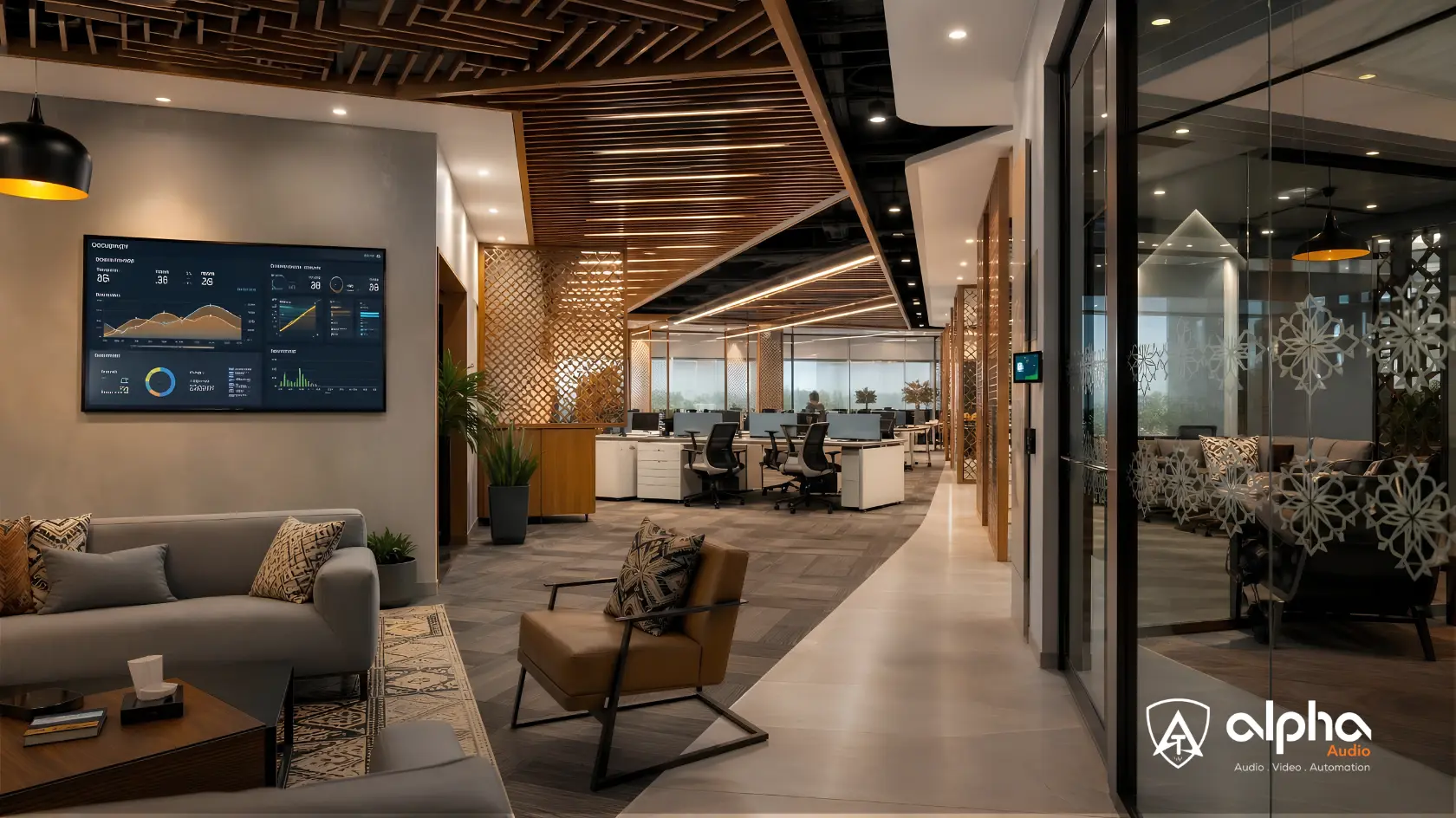
A smart office is a workspace where multiple building systems — lighting, climate control, audiovisual (AV) equipment, and access/security systems — are automated and, more importantly, integrated into a single intelligent network. Instead of operating in isolated silos, every system “talks” to the others, working together to create a responsive, efficient, and secure environment.
Here’s what that looks like in practice:
- Automated Lighting Sensors detect occupancy and natural daylight levels, automatically adjusting brightness across the office. Lights dim in unused meeting rooms and brighten in active workspaces no manual switches required.
- Smart Climate Control (HVAC) Temperature and ventilation adjust automatically based on room occupancy, time of day, and even weather conditions outside, keeping employees comfortable while cutting unnecessary energy usage.
- Integrated AV Systems Boardrooms and conference halls are equipped with professional-grade audio and visual technology that activates with a single touch — ideal for presentations, video conferencing, and client meetings that actually leave an impression.
- Access Control & Security Smart locks, biometric systems, and card-based access replace traditional keys, giving businesses full control and visibility over who enters which part of the building, and when.
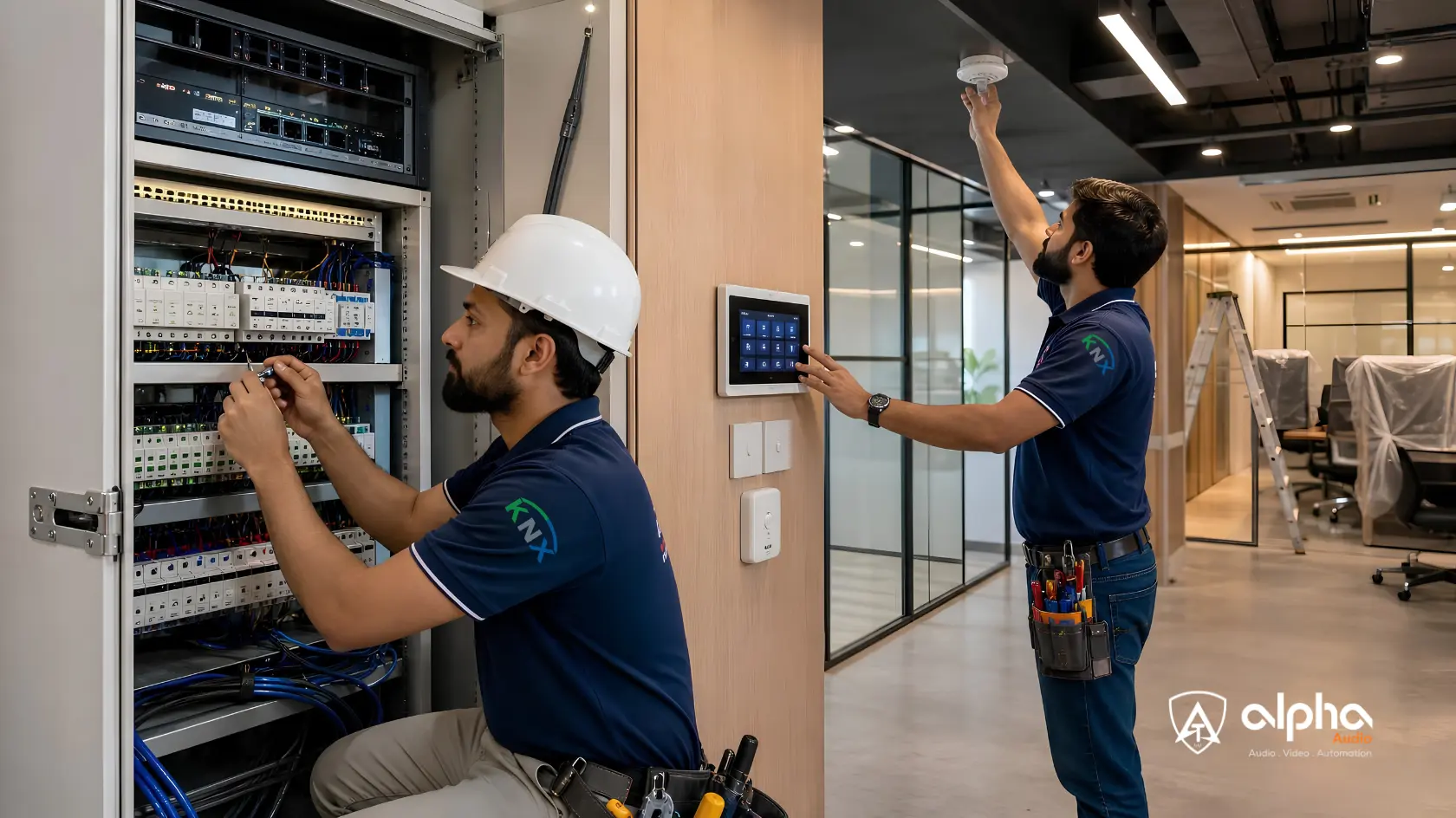
The real magic happens when these systems are unified under one building automation protocol most commonly KNX technology, the global standard for intelligent building automation. With KNX, lighting, climate, security, and AV systems don’t just operate automatically they communicate with each other. A single mobile app or central control panel can manage an entire floor, or an entire building, with just a few taps.
This is the difference between “having smart gadgets” and “having a smart office.” One is a collection of devices. The other is an intelligent ecosystem.
The Proof: Why Businesses Worldwide Are Making the Switch
Skeptical business owners often ask: does automation actually deliver results, or is it just marketing hype? The data says otherwise.
Industry research consistently points to measurable gains from office automation:
- Market analysts valued the global smart and connected office industry at roughly $43 billion in 2023, with projections pointing to nearly $122 billion by 2032 — a clear sign of how rapidly businesses worldwide are adopting these systems.
- Reports indicate that smart lighting systems can cut energy consumption by as much as 30%, while smart thermostats typically save businesses 10–12% on heating and cooling costs.
- By 2025, an estimated 80% of companies were expected to have adopted some form of workplace automation a number only expected to climb through 2026 and beyond.
- Smart office implementations have also been linked to higher employee engagement, with some studies reporting satisfaction increases of up to 20% in automated work environments.
- Beyond energy savings, broader market forecasts point to the smart office sector growing roughly 13% by 2026, approaching a value of nearly $60 billion driven largely by the productivity, efficiency, and improved workspace experience that automation delivers.
(Figures compiled from industry market research reports, including SNS Insider and TechRadar/Sony Professional Solutions industry commentary.)
For Pakistani businesses facing constant pressure from rising electricity tariffs and increasing operational costs, these aren’t just impressive statistics they represent real, tangible savings that go straight back into the bottom line. Lower energy bills, fewer maintenance headaches, improved employee retention, and a workspace that reflects a forward-thinking brand that’s the real ROI of a smart office.
Why Sound and Visual Quality Are the Heart of a True Smart Office
Here’s something most smart office guides overlook: automation means nothing if the experience it delivers is mediocre. A boardroom with automated lights but a crackling, unclear sound system isn’t a smart office — it’s a half-finished one.
This is exactly where Alpha Audio sets Pakistani businesses apart.
World-Class Sound with RCF and L-Acoustics
When it comes to audio, not all speakers are created equal. Alpha Audio proudly deals in RCF and L-Acoustics — two of the most respected names in professional sound engineering worldwide, trusted by concert venues, corporate auditoriums, and boardrooms across the globe. Whether it’s a town hall meeting, a client presentation, or a company-wide announcement, our sound solutions ensure every word is heard with absolute clarity — no distortion, no dead zones, no compromises.
Seamless Automation with KNX Technology
Alpha Audio specializes in KNX-based automation systems, the same globally certified standard used in smart buildings around the world. From lighting scenes to climate scheduling to integrated access control, our KNX solutions bring every system in your office under one intelligent, easy-to-use interface — designed specifically for the needs (and budgets) of Pakistani businesses.
Stunning Visuals with High-End LED Projectors and LED Screens
First impressions matter, especially in boardrooms and client-facing spaces. Alpha Audio offers high-end LED projectors and LED video walls that transform ordinary meeting rooms into immersive, professional presentation spaces. Sharp visuals, vibrant colors, and reliable performance make every pitch, product demo, or quarterly review look as impressive as the numbers behind it.
How to Choose the Right Smart Office Partner in Pakistan
Not every vendor claiming to offer “smart office solutions” actually delivers an integrated system. Before signing a contract, Pakistani businesses should evaluate potential partners on a few key criteria:
- Proven Technology Brands, Not Unbranded Imports Ask what hardware is actually being installed. Generic, unbranded lighting controllers or no-name speakers may look similar on paper, but they fail faster, sound worse, and lack proper local support. Working with globally recognized names — like KNX for automation and RCF or L-Acoustics for audio — ensures long-term reliability and easy access to spare parts and upgrades.
- True System Integration, Not Standalone Devices A vendor selling you a smart thermostat and a separate smart light app isn’t offering a smart office — they’re offering two disconnected products. Insist on a single, centralized control system that manages lighting, climate, AV, and access together.
- Local Installation and After-Sales Support Smart office systems require professional installation, calibration, and ongoing maintenance. A partner with a physical presence and trained technicians in Pakistan will always outperform an overseas supplier who disappears after the sale.
- Scalability for Future Growth Your smart office should be able to grow with your business — adding new meeting rooms, additional floors, or new branches without needing to rebuild the entire system from scratch.
This is precisely the standard Alpha Audio holds itself to on every project — from a single boardroom upgrade to a full-building automation rollout.
FAQs
Is a smart office expensive to set up?
Costs vary depending on the size of the office and the scope of automation required. Many businesses start with one high-impact area — such as a boardroom AV and lighting upgrade — and expand gradually, making smart office adoption far more affordable than most business owners assume.
Can smart office systems be added to an existing building?
Yes. Most modern automation systems, including KNX-based solutions, can be retrofitted into existing office spaces without major structural changes, making them practical for both new construction and renovation projects across Pakistan.
What's the difference between a smart office and just buying smart devices?
Individual smart devices operate in isolation. A true smart office integrates lighting, climate, AV, and security into one unified, centrally controlled system — which is where the real efficiency and cost savings come from.
How long does it take to install a smart office system?
Timelines depend on the scale of the project, but a single boardroom or meeting room upgrade can often be completed in a matter of days, while full-building automation projects are typically phased over several weeks.
The Bottom Line: Don’t Let Your Competitors Get There First
The businesses that will lead Pakistan’s corporate landscape in 2026 and beyond are the ones investing in smart infrastructure today. A smart office isn’t a gadget purchase — it’s a long-term investment in productivity, cost savings, employee satisfaction, and brand perception.
Alpha Audio brings together everything a true smart office needs under one roof:
RCF and L-Acoustics sound systems, KNX automation technology, and high-end LED projectors and screens all designed, installed, and supported by a team that understands the unique needs of businesses in Pakistan.
+92 308 4319219 | info@alphaaudio.com.pk | alphaaudio.com.pk
Visit us: Plaza No. 28, Phase 6 DHA, Lahore, Punjab
Audio Quotation
Video Quotation
Automation Quotation