


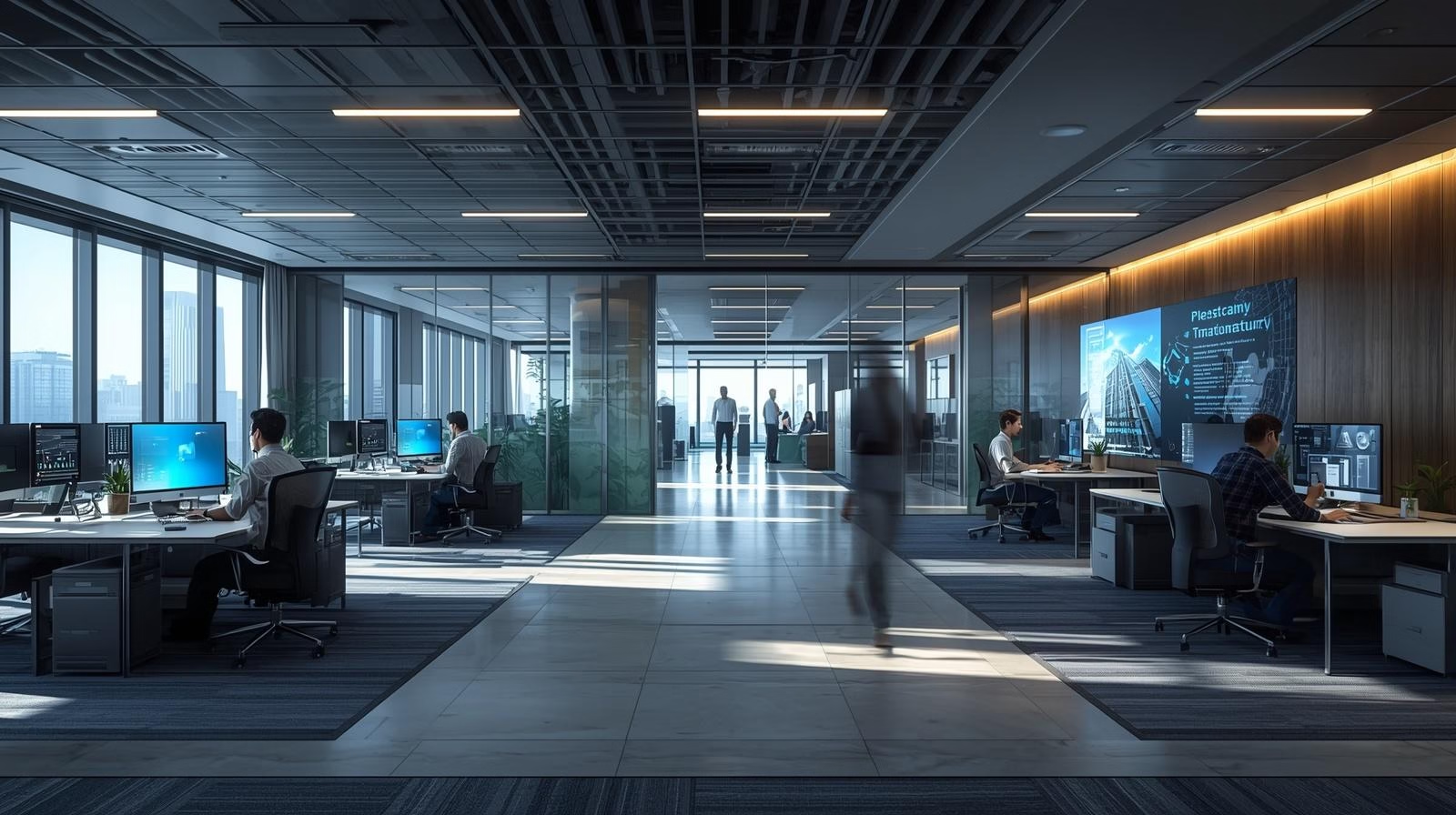
Introduction: The Future of Corporate Offices Has Arrived in Pakistan
Pakistan’s corporate landscape is evolving fast. Businesses in Lahore, Karachi, Islamabad, and beyond are no longer just asking how to cut costs — they’re asking how to work smarter. The answer, increasingly, is KNX automation.
KNX is the world’s only open standard for building and home automation, used in over 190 countries and trusted by more than 500 certified manufacturers globally. From intelligent lighting control and HVAC management to energy monitoring and access control, KNX smart office systems are redefining what a modern corporate workspace looks like.
If your business is still operating with manual switches, outdated thermostats, and disconnected systems, you’re leaving money on the table — and falling behind competitors who have already embraced smart building automation in Pakistan.
This guide breaks down everything you need to know: what KNX is, how it works in a corporate setting, its tangible benefits, real-world use cases, and why now is the right time to invest in KNX automation for your office in Pakistan.
What Is KNX Automation? A Quick Primer
KNX (Konnex) is an internationally standardized (ISO/IEC 14543-3), open-source communication protocol for building automation. Unlike proprietary systems that lock you into a single brand, KNX allows devices from hundreds of certified manufacturers to work together seamlessly on one unified platform.
Think of KNX as the “universal language” that your lights, air conditioning, curtains, security cameras, energy meters, and meeting room panels all speak fluently, simultaneously, and intelligently.
KNX vs. Traditional Building Systems
| Feature | Traditional Systems | KNX Automation |
|---|---|---|
| Integration | Siloed, brand-locked | Open, multi-brand |
| Control | Manual or basic timers | Intelligent, scene-based |
| Energy Monitoring | Limited or none | Real-time, granular |
| Scalability | Costly to expand | Easily scalable |
| Remote Access | Rarely available | Full remote control |
| ROI Timeline | N/A | 2–5 years typically |
Why KNX Automation Is Gaining Momentum in Pakistani Corporate Offices
Pakistan’s commercial real estate and corporate sector is experiencing a significant shift. Several macro factors are pushing businesses toward smart building solutions in Pakistan:
- Rising energy costs — Electricity tariffs in Pakistan have surged significantly over the past few years, making energy efficiency no longer optional for cost-conscious businesses.
- Load shedding pressures — Companies are investing in smarter energy management to maximize efficiency during available grid hours and reduce dependence on expensive generator power.
- Global compliance expectations — Multinational companies operating in Pakistan increasingly require their local offices to meet international sustainability and smart-building standards.
- Talent attraction — Modern, tech-forward office environments attract and retain skilled professionals.
- Green building certifications — LEED and BREEAM certifications, which boost property values and corporate reputation, often require or favor building automation systems.
Top Benefits of KNX Automation for Corporate Offices in Pakistan
1. Dramatic Energy Savings — Up to 40%
Energy consumption is one of the largest operational costs for any corporate office in Pakistan. KNX building automation systems optimize energy use by:
- Automatically switching off lights, AC, and equipment in unoccupied zones
- Adjusting HVAC based on occupancy sensors and outdoor weather conditions
- Scheduling energy-intensive systems during off-peak hours
- Generating real-time energy consumption dashboards for facility managers
Result: Businesses implementing KNX smart office automation typically report energy savings of 25% to 40%, directly reducing electricity bills.
2. Centralized Control of the Entire Building
With a KNX system, your entire office — across multiple floors or even multiple buildings — is managed from a single interface. Facility managers can:
- Control all lighting, HVAC, shading, and AV systems from one dashboard
- Set automated scenes (e.g., “Morning Mode”, “Presentation Mode”, “After-Hours Mode”)
- Monitor and control everything remotely via smartphone or tablet
- Receive real-time alerts for faults or anomalies
This centralized building management system eliminates the need for manual rounds and reactive maintenance, replacing them with proactive, data-driven facility management.
3. Enhanced Occupant Comfort and Productivity
Numerous global studies link workplace environmental comfort — temperature, lighting quality, air quality — to employee productivity. KNX automation addresses all three:
- Lighting control: Automatically adjusts lighting intensity based on daylight levels and occupancy, reducing eye strain
- Climate control: Maintains consistent, zone-specific temperatures throughout the workday
- Motorized shading: Reduces glare on screens and manages solar heat gain
When employees are comfortable, they perform better. It’s that simple.
4. Seamless Meeting Room and AV Integration
Corporate meeting rooms in Pakistan are often plagued by technical complexity — separate systems for lights, projectors, blinds, and AC that require manual coordination. KNX automation solves this with one-touch scene control:
- Press “Meeting Start” → lights dim, projector lowers, blinds close, AC adjusts
- Press “Presentation Mode” → all AV and environmental settings reconfigure instantly
- Integrate with room booking systems to auto-prepare rooms before meetings begin
This saves time, reduces IT support calls, and impresses clients visiting your office.
5. Robust Security and Access Control Integration
KNX systems integrate smoothly with access control, CCTV, and intrusion detection systems, creating a unified security ecosystem:
- Automatic lockdown of zones after working hours
- Integration with biometric entry systems
- Motion-triggered lighting for car parks and corridors
- Remote monitoring of security systems via mobile apps
For corporate offices in Pakistan handling sensitive operations, this level of integrated security is invaluable.
6. Future-Proof and Scalable Infrastructure
One of KNX’s greatest strengths is its open-standard architecture. This means:
- You are never locked into one vendor or brand
- New devices and functionalities can be added as your business grows
- Software updates keep the system current without hardware replacement
- KNX integrates with modern IoT platforms, voice assistants, and cloud services
Whether you’re a startup in a single office or a corporation with multiple sites across Pakistan, KNX scales with you.
7. Reduced Maintenance Costs
KNX systems are inherently self-monitoring. Fault detection, predictive maintenance alerts, and remote diagnostics significantly reduce the cost and frequency of on-site maintenance visits — a major advantage in cities like Karachi and Lahore where traffic alone makes facility management challenging.
8. LEED & Green Building Certification Support
If your organization is pursuing LEED, BREEAM, or other green building certifications, a KNX building automation system actively contributes to achieving certification points in categories such as:
- Energy & Atmosphere
- Indoor Environmental Quality
- Innovation in Design
This not only boosts your property’s value but demonstrates your company’s commitment to sustainability — an increasingly important factor for clients, investors, and regulators in Pakistan.
KNX Automation Use Cases in Corporate Offices
Use Case 1: Open-Plan Office Floors
Large open-plan offices often waste enormous energy by illuminating and conditioning empty zones. KNX occupancy sensors automatically:
- Switch off lights in empty sections
- Reduce HVAC output in unoccupied areas
- Report zone-by-zone occupancy data to facility managers
Real-world impact: A multi-floor corporate office in Lahore with 200+ workstations can save hundreds of thousands of rupees annually in electricity costs alone.
Use Case 2: Executive Suites and C-Suite Offices
High-level executives benefit from personalized environment control:
- One-touch “Do Not Disturb” scenes that dim lights, close blinds, and set a preferred temperature
- Automatic adjustment of settings when the executive enters or leaves
- Integration with voice assistants (Amazon Alexa, Google Assistant) for hands-free control
Use Case 3: Conference Rooms and Boardrooms
As described above, KNX transforms boardrooms into seamlessly intelligent spaces — reducing setup time, eliminating technical glitches, and creating a polished, professional experience for both internal and external stakeholders.
Use Case 4: Reception and Common Areas
First impressions matter. KNX automation ensures your reception area is always perfectly lit and conditioned:
- Dynamic lighting scenes that adjust throughout the day
- Automatic energy reduction during non-business hours
- Background music and digital signage integration
Use Case 5: Server Rooms and IT Infrastructure Areas
Server rooms require precise, consistent cooling. KNX automation:
- Monitors temperature continuously and adjusts HVAC accordingly
- Sends instant alerts if temperature thresholds are breached
- Maintains audit logs for compliance purposes
Use Case 6: Parking Areas and Building Perimeter
- Motion-activated lighting in car parks saves significant energy
- Integration with security cameras for automated alerts
- ANPR (Automatic Number Plate Recognition) integration for corporate vehicle management
Use Case 7: Multi-Tenant Commercial Buildings
For property developers and building owners in Pakistan, KNX provides:
- Individual energy metering per tenant for accurate billing
- Centralized building management while maintaining tenant privacy
- Increased rental value and tenant attractiveness
KNX Automation in Major Pakistani Cities
KNX Automation in Lahore
Lahore’s booming commercial real estate market — from Gulberg to DHA Phase 6 and beyond — is seeing increasing demand for smart office buildings. Businesses investing in KNX automation in Lahore are positioning themselves as premium, forward-thinking employers and service providers.
KNX Automation in Karachi
As Pakistan’s financial capital, Karachi hosts the headquarters of major banks, multinationals, and conglomerates. KNX smart building systems in Karachi are being adopted by companies seeking to reduce massive energy bills in large commercial towers and to meet global corporate standards.
KNX Automation in Islamabad
With its concentration of government offices, embassies, tech companies, and luxury commercial developments, Islamabad is a natural fit for KNX building automation. Smart offices in the capital signal modernity, security, and operational excellence.
How Much Does KNX Automation Cost in Pakistan?
KNX automation is a premium investment with measurable ROI. Costs vary based on:
- Size of the office (sq ft / number of floors)
- Scope of automation (lighting only vs. full integration)
- Brand choices (there are 500+ KNX-certified manufacturers across price points)
- Installation complexity and local labor
Typical ROI Timeline: Most corporate offices in Pakistan recover their KNX investment within 2 to 5 years through energy savings alone — not counting the productivity, maintenance, and property value benefits.
What to Look for in a KNX Automation Partner in Pakistan
Choosing the right KNX installer and integrator in Pakistan is critical. Look for:
- ✅ KNX Certified Partners — Ensure your integrator holds official KNX certification
- ✅ Proven corporate project portfolio — Ask for case studies and references
- ✅ Post-installation support — KNX systems need ongoing programming support
- ✅ Brand-agnostic approach — A good partner recommends the best solution, not just what they sell
- ✅ Training for your team — Your facility managers should understand the system
KNX Automation vs. Other Smart Office Systems in Pakistan
You may have encountered other smart building systems — Crestron, Control4, Lutron, or local brand-specific solutions. Here’s why KNX stands apart:
| Criteria | KNX | Proprietary Systems (Crestron, etc.) |
|---|---|---|
| Open Standard | ✅ Yes | ❌ No |
| Multi-brand compatibility | ✅ Yes | ❌ Limited |
| Long-term vendor independence | ✅ Yes | ❌ No |
| Global support availability | ✅ 190+ countries | Limited |
| Scalability | ✅ Excellent | Moderate |
| Integration flexibility | ✅ Very high | Moderate |
Conclusion: The Smart Office Is No Longer a Luxury — It’s a Competitive Necessity
Pakistan’s corporate sector is at an inflection point. Energy costs are rising, talent expectations are shifting, and global business standards are becoming the baseline, not the benchmark. KNX automation for corporate offices in Pakistan is not a futuristic concept — it is a proven, practical, and increasingly accessible solution that delivers measurable results from day one.
Whether you’re building a new corporate campus, renovating an existing office, or simply looking to reduce your electricity bill and future-proof your workspace, a KNX smart building system is the single most impactful investment you can make in your office infrastructure.
Frequently Asked Questions (FAQs)
Is KNX automation suitable for small offices in Pakistan?
Yes. KNX is scalable and works for offices of all sizes, from a 10-person startup to a 1,000-person corporate campus. Entry-level KNX deployments focused on lighting and HVAC control can be very cost-effective even for smaller offices.
Can KNX be retrofitted into an existing office building?
Absolutely. While KNX is easiest to install during construction, it can be retrofitted into existing buildings using wireless KNX components (KNX RF), minimizing disruption to ongoing operations.
Does KNX work during power outages?
KNX systems can be integrated with UPS backup power and generator systems to maintain critical functions, including security and emergency lighting during load shedding or outages, which is particularly relevant in the Pakistani context.
How long does a KNX installation take for a corporate office?
Timeline depends on project scope. A single-floor office automation project might take 2–4 weeks. A full multi-floor corporate building could take 3–6 months. Your KNX integrator should provide a detailed project timeline.
Can I control a KNX system from my smartphone?
Yes. KNX systems integrate with leading visualization and control apps (such as MDT, Gira, or Jung), giving you full remote control from anywhere with an internet connection.